Find the Best Mosquito Control Companies for Your Business
No obligation • Fast responses • Nationwide coverage

Why you can trust Pest Crews
Pest Crews is a leading U.S. resource for finding and evaluating residential and commercial pest control services. Our team researches providers, reviews treatment approaches, and organizes unbiased information to help you make informed decisions. Companies cannot pay to change our editorial content or influence how they appear.
Search providers near you
Best Mosquito Control Companies in Massachusetts Ranked
Managing mosquitoes in Massachusetts is a critical public health and quality-of-life service, especially given the state's history with mosquito-borne illnesses like Eastern Equine Encephalitis (EEE) and West Nile Virus. A structured, publicly-funded system exists to protect residents and businesses through comprehensive surveillance and targeted treatments. This guide explains how mosquito abatement works in the Commonwealth, detailing the services available, how they are funded, and how you can participate or opt-out, helping you understand your local resources and options for a more comfortable outdoor environment.
Freedom Pest Control
58 Pulaski St Unit Business 2, Peabody, MA 01960
Freedom Pest Control is a pest management company serving Boston, MA, with over 30 years of experience since 1994. They provide a wide range of pest control services including ant, rodent, bed bug, termite, mosquito, and wildlife removal. Their approach involves thorough inspections and customized treatment plans to address the root causes of infestations. The company also offers specialized services such as stinging insect control and eco-friendly mosquito and tick management. With a focus on safety and effective solutions, Freedom Pest Control helps homeowners protect their properties from various pests.

Mosquito Joe of Andover-Peabody
28 Teal Rd, Wakefield, MA 01880
Mosquito Joe of Andover-Peabody provides eco-friendly pest control services in Boston, MA, specializing in mosquito, tick, rodent, ant, cockroach, and commercial pest management. Their science-driven approach includes creating protective barriers and targeted treatments to prevent infestations and protect outdoor spaces. The company offers year-round pest control with flexible service plans tailored to seasonal pest activity. Mosquito Joe emphasizes environmentally responsible methods and supports both residential and commercial clients in maintaining pest-free environments.

Bug Bully Rodent & Pest Control
21 SW Cutoff, Northborough, MA 01532
Bug Bully Rodent & Pest Control is a family-owned pest control company based in Worcester, MA. Serving Worcester County and surrounding areas, they specialize in comprehensive pest management including rodent exclusion, general pest control, termite inspections, mosquito and tick treatments, and wildlife removal. Their BullGuard Rodent Exclusion System uses custom-fabricated barriers to permanently seal entry points and prevent rodent infestations without chemicals. Founded in 2013, Bug Bully has over 20 years of combined experience and offers fast service with protection plans that provide ongoing pest prevention.

Mosquito Joe of Walpole-Waltham
32 R Spring St, Medfield, MA 02052
Mosquito Joe of Walpole-Waltham provides eco-friendly pest control services in Boston, MA, specializing in mosquito, tick, rodent, ant, cockroach, and commercial pest management. Their approach includes building pest-repelling barriers and offering year-round protection tailored to the unique needs of each property. The company uses EPA-registered treatments and emphasizes prevention to minimize pest-related damage. Mosquito Joe is backed by urban entomologists and holds a PESP Gold designation, reflecting their commitment to science-driven and environmentally responsible pest control.

ohDEER Metro West
260 Boston Post Rd, Wayland, MA 01778
ohDEER Metro West is a pest control company based in Boston, MA, specializing in natural mosquito, tick, and deer repellent services. They use plant-based, eco-friendly products that are safe for families and pets while effectively reducing pest populations. Their unique spray method ensures thorough coverage, helping protect yards from deer damage and tick-borne illnesses. Founded by Kurt Upham, who developed the natural deer repellent in 2006, the company has been serving the Metro West area, including Wayland, Weston, Sudbury, Lincoln, and Dover, for nearly two decades.
Understanding Massachusetts's Mosquito Control System
Massachusetts operates one of the nation's most organized public mosquito management frameworks. The system is designed to be proactive, data-driven, and community-focused, prioritizing prevention and public health over reactive spraying.
The backbone of this effort is the network of 11 regional Mosquito Control Projects (MCPs). These projects are overseen by the State Reclamation and Mosquito Control Board (SRMCB). Each MCP serves a specific group of member cities and towns. If your municipality is a member, you automatically receive the core suite of mosquito management services. This structure ensures that control efforts are coordinated across town lines, as mosquitoes do not respect municipal borders.
Funding for these projects comes primarily through annual assessments on member towns, which are typically paid from municipal property tax revenues 1. This means that for residents and businesses within a participating town, the foundational surveillance, larval control, and public health response services are covered indirectly-you generally will not receive a bill for a routine spray or larval treatment conducted by your local MCP. This public-health model emphasizes community-wide protection.
Core Services: The Integrated Pest Management (IPM) Approach
Massachusetts mosquito control follows an Integrated Pest Management (IPM) philosophy. This science-based strategy uses multiple tactics to manage mosquito populations effectively and responsibly, minimizing reliance on broad pesticide applications. The key components include:
Surveillance and Monitoring
This is the critical first step. MCPs deploy hundreds of mosquito surveillance traps across their regions. Staff collect mosquitoes regularly, count them to gauge population levels, and send samples to state labs to test for dangerous viruses like EEE and West Nile. This data dictates all subsequent actions, ensuring control measures are justified and targeted.
Larval Control (Source Reduction and Larviciding)
The most effective and environmentally sensitive control happens before mosquitoes become flying, biting adults. MCPs focus on eliminating or treating standing water where mosquitoes breed.
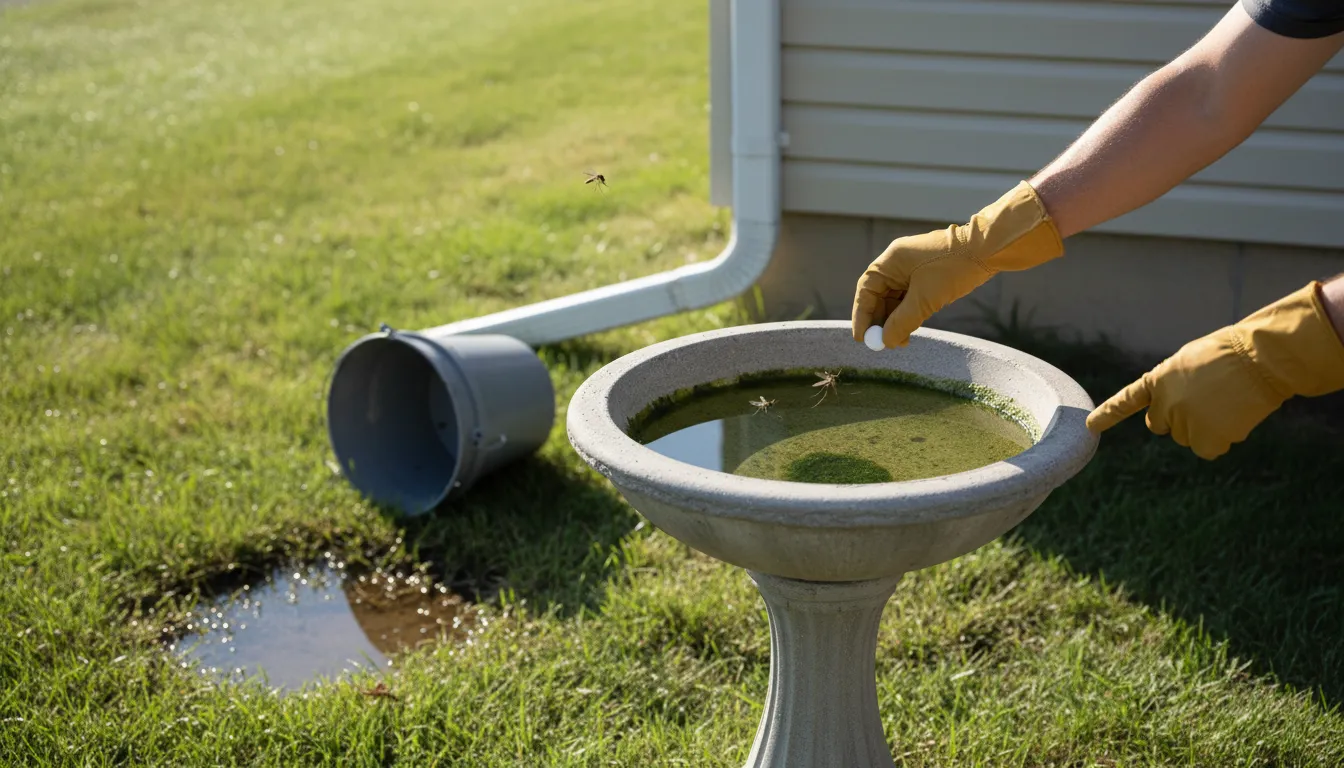
- Source Reduction: This involves physically removing breeding sites. Projects may conduct ditch maintenance to improve water flow, remove discarded tires, and educate the public on emptying containers like bird baths and clogged gutters 2.
- Biological Larviciding: When water cannot be drained, MCPs apply biological larvicides like Bacillus thuringiensis israelensis (Bti) to ponds, catch basins, and wetlands. Bti is a bacterium toxic only to mosquito and black fly larvae and is harmless to humans, pets, and most other wildlife. This proactive treatment happens early in the season (spring and early summer).
Adulticiding (Mosquito Spraying)
When surveillance data indicates high adult mosquito populations or a heightened risk of disease transmission, MCPs may initiate adulticide applications.
- Ground Spraying: This is the most common method, using truck-mounted ultra-low volume (ULV) sprayers that release a fine mist of EPA-registered adulticide in the early evening 3.
- Aerial Spraying: In cases of widespread, severe public health risk (such as an EEE outbreak), the state may authorize aerial spraying over larger areas to rapidly reduce the infected mosquito population 4.
- Notification: MCPs are required to provide public notice before spraying. Notifications are typically posted on town websites, through local media, and sometimes via automated alert systems 5.
Public Education and Exclusion
A key part of any IPM program is public cooperation. MCPs provide resources on how residents can "fight the bite" by using repellent and eliminating backyard breeding sites 6. They also administer a formal "No Spray" or exclusion program. Residents who do not wish their property to be included in truck-based adulticide applications can submit an exclusion request form and must place visible white marker plates (at least 9 inches in diameter) on their property boundary. This opt-out process is free but requires annual renewal.
Find the perfect mosquito control companies for your needs
Get personalized recommendations and expert advice
What to Expect: Service Schedules and Participation
Mosquito control in Massachusetts is a seasonal operation, typically running from May through October, with peak activity aligning with warm weather and mosquito activity 7.
- Spring: Focus is on surveillance, ditch maintenance, and early-season larval control.
- Summer: Larval control continues; adult mosquito surveillance intensifies. Adulticiding may begin if thresholds are met.
- Late Summer/Fall: This is often the highest risk period for EEE. Surveillance for the virus is constant, and adulticiding may be most frequent if virus activity is detected.
Participation for residents is straightforward if you live in a member town. Your property is included in the district's area-wide management plan. To find your local project, contact your town's Board of Health or visit the SRMCB website for a list of projects and their member communities.
For businesses, especially those with large properties like golf courses, resorts, or outdoor event spaces, the public MCP provides a baseline of area-wide protection. However, many businesses choose to hire private mosquito control services for more frequent, customized treatments focused on their immediate grounds, especially in high-traffic outdoor dining or recreation areas.
Commercial and Private Property Considerations
While the public system provides essential community-wide protection, there are scenarios where private mosquito management is sought:
- Immediate Perimeter Control: Businesses may want more frequent barrier treatments around patios, entrances, and seating areas.
- Event-Based Needs: For weddings, festivals, or other outdoor gatherings, a one-time treatment before the event can be arranged.
- Enhanced Personal Property Control: Homeowners with severe mosquito problems due to nearby wetlands or who desire a specific treatment schedule may contract for private service.
Private services operate independently of the MCPs and charge direct fees. They typically focus on applying residual barrier treatments to vegetation and structures around a home or business. It's important to note that private treatments do not replace the public health surveillance and larval control work of the MCP, which addresses the mosquito population at its source.
Costs and Funding: A Public Health Investment
As outlined, the core mosquito abatement services for residents in member towns are funded municipally through property tax assessments. There is no direct per-service charge for the MCP's work 8 9. This reflects the service's status as a public health utility.
Costs for private services vary based on property size, frequency of service, and the company. These are out-of-pocket expenses paid directly to the service provider. For the public "No Spray" exclusion, there is no fee, but residents must comply with the marking requirements 10 11.
Frequently asked questions
Sources
Footnotes
-
Massachusetts Mosquito Control Project services - Mass.gov - https://www.mass.gov/doc/massachusetts-mosquito-control-project-services/download ↩
-
massachusetts mosquito control - annual operations report - Mass.gov - https://www.mass.gov/doc/2024-northeast-annual-operations-report/download ↩
-
CENTRAL MASSACHUSETTS MOSQUITO CONTROL ... - https://www.cmmcp.org/sites/g/files/vyhlif2966/f/uploads/cmmcp_services_manual_0.pdf ↩
-
The Commonwealth of Massachusetts - Mass.gov - https://www.mass.gov/doc/board-operational-response-plan/download ↩
-
MASSACHUSETTS MOSQUITO CONTROL ANNUAL ... - https://downloads.regulations.gov/EPA-HQ-OW-2010-0257-0151/attachment_39.pdf ↩
-
Mosquito control and spraying - Mass.gov - https://www.mass.gov/info-details/mosquito-control-and-spraying ↩
-
Central Massachusetts Mosquito Control Project July 2025 ... - https://www.worcesterma.gov/announcements/central-massachusetts-mosquito-control-project-july-2025-availability-announced ↩
-
MASSACHUSETTS MOSQUITO CONTROL - Mass.gov - https://www.mass.gov/doc/northeast-10/download ↩
-
State Reclamation and Mosquito Control Board (SRMCB) - https://www.mass.gov/state-reclamation-and-mosquito-control-board-srmcb ↩
-
Bristol County Mosquito Control Project - Mass.gov - https://www.mass.gov/orgs/bristol-county-mosquito-control-project ↩
-
MASSACHUSETTS MOSQUITO CONTROL - Mass.gov - https://www.mass.gov/doc/northeastannualoperationsreport2021/download ↩