
Find the Best Wasp & Hornet Removal Companies for Your Business
No obligation • Fast responses • Nationwide coverage

Why you can trust Pest Crews
Pest Crews is a leading U.S. resource for finding and evaluating residential and commercial pest control services. Our team researches providers, reviews treatment approaches, and organizes unbiased information to help you make informed decisions. Companies cannot pay to change our editorial content or influence how they appear.
Search providers near you
Top Wasp & Hornet Removal Companies in Toms River, New Jersey Ranked
Discovering a buzzing nest of stinging insects on your Toms River property can be unsettling and dangerous. Professional bee and wasp removal services are essential for safely addressing these pests, protecting your family, and preserving beneficial pollinators like honeybees. This guide will help you understand the local stinging insect landscape, the importance of expert intervention, and how to connect with qualified pest management professionals in Ocean County who can assess and resolve your specific situation.
Ecosafe Pest Management LLC
New York, NY
Ecosafe Pest Management LLC provides pest control services in New York, NY, covering the five boroughs, Westchester County, Long Island, and New Jersey. They offer treatments for a wide range of pests including bed bugs, cockroaches, ants, rodents, termites, bees, wasps, and pest birds. Their team uses environmentally responsible methods that are safe for families and pets, and they serve both residential and commercial clients. Ecosafe has built a reputation for comprehensive and tailored pest management solutions. They provide 24/7 callout service with quick response times and insured, guaranteed treatments.
Divine Pest Specialist
Newark, NJ
Divine Pest Specialist is a family-owned pest control company serving Newark, NJ. Established in 2018 with 20 years of experience, they provide residential and commercial pest management using Integrated Pest Management (IPM) techniques. Their services cover a wide range of pests including termites, bed bugs, roaches, mosquitoes, rodents, ants, bees, wasps, hornets, and wildlife removal. The company focuses on tailored, non-chemical solutions that consider economic, social, and environmental factors to achieve long-term pest control results. Divine Pest Specialist is fully insured, licensed, and a member of national and state pest management associations.
Understanding Your Stinging Insect Problem
Not all flying, stinging insects are the same, and proper identification is the first step toward a safe and effective solution. In Toms River, homeowners commonly encounter several species, each with distinct nesting habits and behaviors that influence the removal approach.
Common Species in Ocean County:
- Yellow Jackets: Often mistaken for bees, these wasps are aggressive defenders of their nests, which are frequently built in the ground in old rodent burrows or within wall voids and other hidden cavities. Their scavenging behavior, especially in late summer, brings them into close contact with people during outdoor activities.
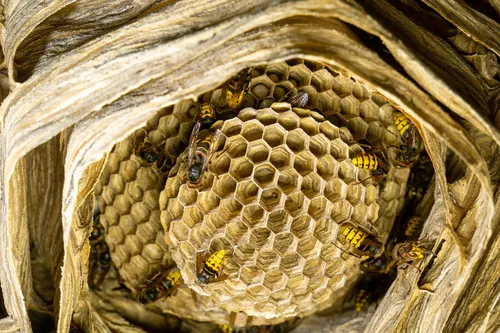
- Paper Wasps & Hornets: This group includes species like bald-faced hornets, which construct large, gray, ball-shaped paper nests in aerial locations such as under eaves, in trees, or on utility poles 1 2. Paper wasps build smaller, open-comb nests often found under porch ceilings, deck railings, and inside attics or sheds.
- Carpenter Bees: These solitary bees are often confused with bumblebees but cause property damage. They drill perfectly round, pencil-sized holes into wooden surfaces like fascia boards, siding, and decks to create tunnels for laying eggs.
- Honeybees: As vital pollinators, honeybees often swarm to find a new home and may establish a colony in a hollow tree, inside a wall, or even in an attic space. Due to their ecological importance, many Toms River pest control companies prioritize humane bee relocation over extermination.
- Mud Daubers: These solitary wasps are less aggressive and build distinctive mud nests, often in sheltered spots like attics, garages, or under porch ceilings 3.
Why Professional Removal is Crucial
Attempting a do-it-yourself approach to bee, wasp, or hornet control can be hazardous. Disturbing a nest often triggers a mass, defensive attack. Professionals have the training, protective equipment, and targeted products to manage the situation safely and effectively.
Key Benefits of Hiring a Pro:
- Safety First: Experts mitigate the risk of painful-and for some, life-threatening-stings for you, your family, and your pets.
- Proper Identification: Correctly identifying the species dictates the correct treatment method, whether it's removal, relocation, or exclusion.
- Complete Elimination: Professionals ensure the entire nest and colony are addressed, preventing survivors from regrouping.
- Preventive Advice: A good technician will point out conditions that attract stinging insects and suggest ways to make your property less inviting.
- Guaranteed Service: Many local providers offer service guarantees, promising follow-up visits if the activity persists after treatment.
The Seasonal Cycle of Stinging Insects in New Jersey
Activity levels for bees, wasps, and hornets in Toms River are not constant; they follow a predictable seasonal pattern driven by temperature and colony life cycles.
- Spring (April-May): Fertilized queens emerge from winter hiding spots in soil or woodpiles and begin scouting for nesting sites. You may see solitary queens starting small nests under eaves or entering wall voids. Colony populations are low during this time 4.
- Summer (June-July): The colony expands rapidly. Workers take over nest-building and foraging duties, and the nest grows in size. Activity becomes much more noticeable as insects constantly travel to and from the nest to gather food (nectar, pollen, or other insects).
- Late Summer & Fall (August-October): This is the peak period for human encounters and the most critical time for removal. Colonies are at their maximum size, and the insects become more aggressive and persistent in scavenging for food, especially sweets, as natural sources dwindle 5 6. The survival instinct makes them more defensive of their nests.
- Winter (November-March): With the first hard frosts, most worker bees and wasps die. Only the newly mated queens survive, finding sheltered spots to overwinter before the cycle begins anew in the spring 7 8.
Understanding this cycle explains why problems often seem to explode in late summer and underscores the value of addressing nests earlier in the season when they are smaller and easier to manage.
Find the perfect wasp & hornet removal companies for your needs
Get personalized recommendations and expert advice
What to Expect During Professional Service
When you contact a Toms River pest control company for stinging insect removal, the process typically follows several key steps designed for thoroughness and your peace of mind.
1. Inspection and Assessment: A technician will perform a detailed inspection of your property to locate all active nests and identify the species involved. They will assess the nest's size, location (e.g., in-ground, aerial, within a structure), and accessibility. This inspection is crucial for developing an effective plan and providing an accurate quote.
2. Treatment Plan and Quote: Based on the inspection, the professional will recommend a specific course of action. For wasps, hornets, and yellow jackets, this usually involves the application of insecticidal dust or sprays directly into the nest entrance. For honeybee colonies inside a structure, a bee removal and relocation specialist may need to carefully extract the comb and hive to save the colony. Most reputable companies in the area offer free inspections and quotes 9.
3. The Removal Process: Using appropriate personal protective equipment, the technician will administer the treatment, often during cooler evening or early morning hours when insect activity is lowest and most members are inside the nest. For difficult-to-reach nests (e.g., high in a tree or deep within a wall), specialized tools and ladders are used.
4. Clean-up and Exclusion: After the colony is eliminated, some services may remove the physical nest to prevent other pests from using it. They may also seal entry points (like carpenter bee holes or cracks in siding) to prevent future infestations 10.
5. Follow-up and Guarantees: Many providers stand behind their work with a service guarantee, offering to return at no additional charge if the problem is not resolved, which provides significant homeowner reassurance 11.
Finding the Right Service Provider in Toms River
Toms River and the broader Ocean County area are served by several pest control companies that specialize in stinging insect management. When evaluating your options, consider the following:
- Specialization: Look for companies that explicitly list bee, wasp, hornet, and yellow jacket removal as a core service. Some, like Surf Termite & Pest Control and Bee-Gone Termite & Pest Control, emphasize humane bee relocation for honeybee swarms 12 13 14.
- Service Philosophy: Companies may differ in their approach. Some focus on immediate reactive removal, while others, like Pest Authority of the Jersey Shore or EcoShield Pest Solutions, may offer integrated seasonal plans that include monitoring and removal of emerging nests as part of a broader home protection program 15 16 17.
- Licensing and Insurance: Always ensure the company is properly licensed by the New Jersey Department of Environmental Protection and carries liability insurance.
- Estimates and Transparency: It is highly advisable to get multiple free quotes. As noted in one local review, pricing can vary significantly between companies for the same job, so comparing estimates is wise 18. A trustworthy company will clearly explain what the quote includes and the methods they intend to use.
Proactive Prevention Tips for Homeowners
While professional removal is best for active nests, you can take steps to make your Toms River yard less attractive to stinging insects:
- Seal Entry Points: In early spring, inspect your home's exterior. Seal cracks in siding, fill holes in mortar, and repair damaged screens on attic vents and windows to prevent queens from entering to build nests.
- Manage Food Sources: Keep trash cans tightly sealed and clean up food and drink spills immediately during outdoor gatherings. Consider using covered compost bins. Avoid leaving pet food outside.
- Reduce Nesting Sites: Regularly inspect common nesting areas like under decks, inside sheds, under eaves, and in play structures. Knock down small, starter nests (the size of a golf ball) early in the spring when only the queen is present-but only if you can do so safely from a distance.
- Landscape Mindfully: Keep tree branches and shrubs trimmed away from your house. Fill in abandoned rodent burrows in your yard, which are prime real estate for yellow jackets.
Frequently asked questions
Sources
Footnotes
-
Bald faced hornet - NJ.gov - https://www.nj.gov/agriculture/divisions/pi/pdf/beeswaspshornetsbrocure.pdf ↩
-
Types of Wasps in Pennsylvania, New Jersey and Delaware - https://emoyer.com/services/pestcontrol/pestlibrary/wasps/ ↩
-
How to Get Rid of Paper & Mud Wasp Nests Above & Underground | Orkin - https://www.orkin.com/pests/stinging-pests/wasps/wasp-nests ↩
-
Are Wasps Active in Spring in Mount Laurel, NJ? Why Am I ... - https://www.rossenvironmentalsolutions.com/wasps-active-spring-mount-laurel-nj-seeing-stinging-insects-april-may/ ↩
-
Stinging Insects in the Fall: Why They're So Active and ... - https://www.actionpestcontrol.com/2025/08/28/stinging-insects-in-the-fall-why-theyre-so-active-and-dangerous-for-ocean-monmouth-county-nj-residents/ ↩
-
Why Bees, Wasps, and Hornets Are So Active in August and ... - https://www.actionpestcontrol.com/2024/08/21/why-bees-wasps-and-hornets-are-so-active-in-august-and-september/ ↩
-
How Weather and Seasons Affect Stinging Insect Activity - https://www.askawayblog.com/2025/10/how-weather-and-seasons-affect-stinging.html ↩
-
Types Of Bugs In NJ & Time Of Year They Are Prevalent - https://4njpest.com/types-of-bugs-in-nj-time-of-year-they-are-prevalent/ ↩
-
Bee, Wasp & Hornet Pest Removal in NJ - https://www.cowleys.com/pests-we-treat/bees-wasps.html ↩
-
Pest Control in Toms River and Ocean County NJ - https://beegonepests.com/residential-pest-control-services/areas-we-serve/new-jersey/ocean-county/toms-river ↩
-
Wasp Exterminator in Tom's River NJ | NJ Hornet Removal - https://pestauthority.com/toms-river/services/hornet-wasp-removal/ ↩
-
Bee Removal in Toms River, NJ - Surf Termite & Pest Control - https://beeremoval.surfpest.com/beeremoval-surfpest-com-toms-river-nj-bee-removal-services/ ↩
-
Bee Removal in Toms River, NJ - Surf Termite & Pest Control - https://beeremoval.surfpest.com/beeremoval-surfpest-com-toms-river-nj-bee-removal-services/ ↩
-
Stinging Insects Removal in Central NJ | Bee-Gone - https://beegonepests.com/residential-pest-control-services/stinging-insects-removal ↩
-
Get Rid of Yellow Jackets, Wasps, and Hornets in Toms River ... - https://www.ecoshieldpest.com/get-rid-of-yellow-jackets-wasps-and-hornets-in-toms-river-nj ↩
-
Wasp Exterminator in Tom's River NJ | NJ Hornet Removal - https://pestauthority.com/toms-river/services/hornet-wasp-removal/ ↩
-
Say Goodbye to Ants, Roaches, and Mice with This Proven Toms ... - https://beegonepests.com/say-goodbye-to-ants-roaches-and-mice-with-this-proven-toms-river-pest-control-plan/ ↩
-
Dan Can Home Services L.L.C - https://www.google.com/viewer/place?mid=/g/11v40__bk0 ↩