Find the Best Wasp & Hornet Removal Companies for Your Business
No obligation • Fast responses • Nationwide coverage

Why you can trust Pest Crews
Pest Crews is a leading U.S. resource for finding and evaluating residential and commercial pest control services. Our team researches providers, reviews treatment approaches, and organizes unbiased information to help you make informed decisions. Companies cannot pay to change our editorial content or influence how they appear.
Search providers near you
Best Wasp & Hornet Removal Companies in Wyoming Ranked
Dealing with stinging insects on your property requires a careful balance of safety, environmental consideration, and effective action. Professional bee and wasp removal in Wyoming involves specialized techniques to address nests and swarms, with a strong emphasis on protecting beneficial pollinators like honeybees when possible. This guide explains the common methods, costs, and legal landscape to help you understand your options and connect with qualified local specialists who can assess your specific situation and provide a safe solution.
Understanding Wyoming's Stinging Insects
Wyoming is home to a variety of stinging insects, each requiring a different approach. Correctly identifying the insect is the first step toward a safe and appropriate resolution.
Honeybees are crucial pollinators and are often protected. A managed honeybee colony may swarm in spring as a natural way to reproduce; these swarms, consisting of a queen and thousands of worker bees clustered on a tree branch or fence, are generally docile as they have no hive to defend. Established nests, however, can be found in wall cavities, attics, or chimneys. Due to their ecological importance, the preferred method for honeybees is live relocation by a beekeeper.
Wasps, including paper wasps, yellow jackets, and hornets, are more aggressive in defending their nests. Their nests can be found under eaves, in shrubs, or within ground burrows and wall voids. Unlike bees, wasps can sting repeatedly. Because they are not significant pollinators and pose a greater safety risk, removal typically involves extermination and nest destruction by a pest control professional using specialized tools like commercial vacuums.
Professional Removal Methods and Techniques
Local professionals employ specific strategies based on the type of insect, nest location, and time of year.
For Honeybee Removal:
- Live Relocation: A beekeeper will carefully collect a swarm or vacuum bees from an established cavity to transfer them to a managed hive. This preserves the colony and is often done for free or a low fee if the swarm is easily accessible.
- Exclusion and Removal: For bees inside a structure, the process is more involved. After the bees are removed, the entry point must be sealed to prevent a new colony from moving in. Any honeycomb left behind must also be removed to avoid attracting other pests or causing damage from melting wax and honey.
For Wasp and Hornet Removal:
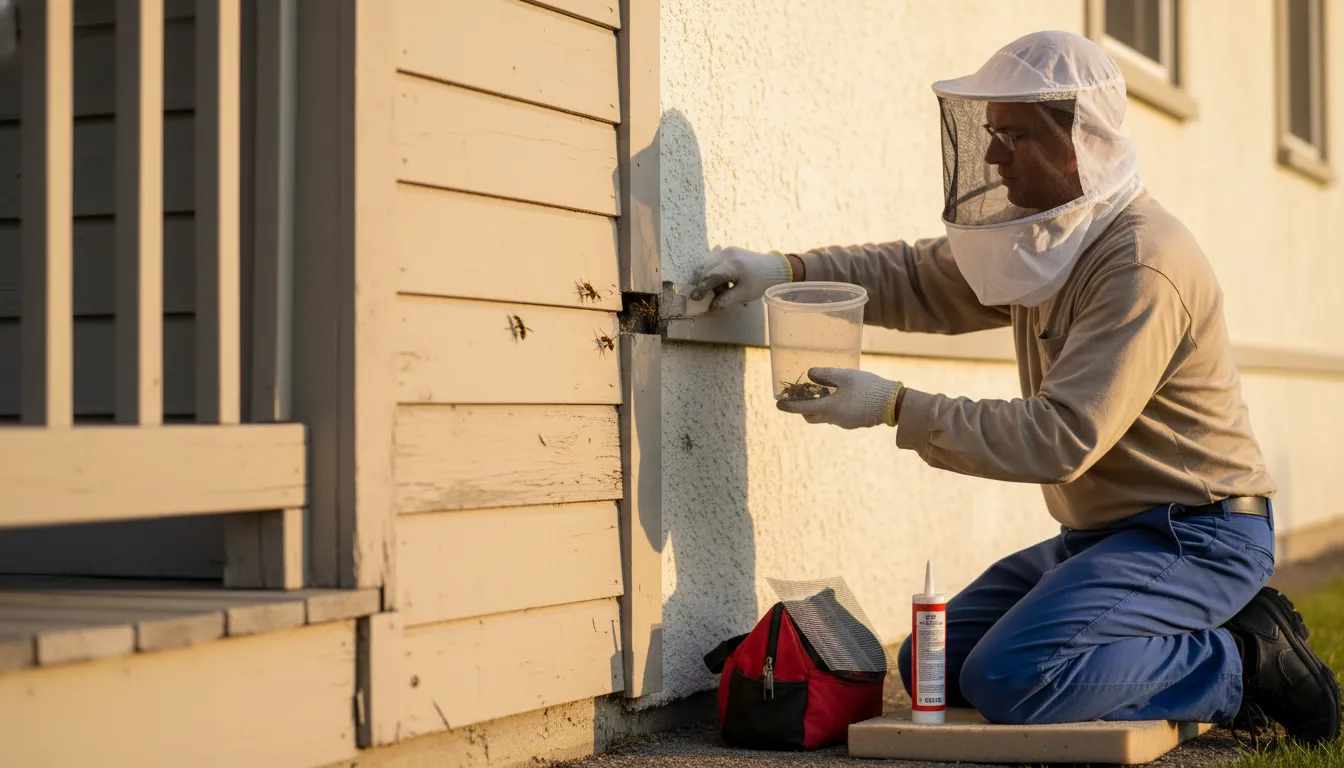
- Extermination and Extraction: Pest control technicians often use insecticidal dust or sprays applied directly to the nest entrance, followed by physical removal. For nests in wall voids, a professional may use a vacuum system to extract insects and debris before sealing the entry point.
- Carpentry Repairs: Removing a nest from within a wall or soffit often requires cutting an access panel, which adds carpentry work and cost to the overall job. The area is then repaired and sealed to prevent re-infestation.
Cost Factors for Removal in Wyoming
The price for bee or wasp removal in Wyoming varies significantly, typically ranging from $100 to over $1,000. Several key factors influence the final cost.
1. Type of Insect:
- Honeybee Swarm: Free to $150. This is the least expensive scenario, especially if a local beekeeper is eager to acquire the bees 1 2.
- Established Honeybee Nest: $100 to $500+. Costs rise if the nest is inside a structure, requiring extraction and cleanup 3 4.
- Wasp or Hornet Nest: $200 to $1,000+. Aggressive insects and harder-to-reach nests command higher prices for the increased risk and labor 5 6.
2. Nest Location and Accessibility: This is the most significant cost driver. A small, exposed paper wasp nest under an eave may cost at the lower end of the scale. A large yellow jacket nest inside a wall void, attic, or underground requires more time, specialized equipment, and potentially carpentry work, pushing costs toward the higher end. Removal from high areas (second-story eaves, tall trees) may also incur additional charges for ladder or lift work.
3. Nest Size and Severity: A small, early-season nest is quicker and safer to treat than a large, mature colony in late summer, which will contain many more insects and require more material and labor to eliminate.
Find the perfect wasp & hornet removal companies for your needs
Get personalized recommendations and expert advice
Seasonal Considerations and Timing
Stinging insect activity in Wyoming follows a predictable seasonal pattern, which affects both the likelihood of an infestation and the approach to removal.
- Spring (April-June): This is peak swarming season for honeybees. Queen wasps and hornets also emerge to begin building new nests. Nests are small and populations are low, making this an ideal and often less expensive time for intervention.
- Summer (July-August): Colonies reach their maximum size. Wasps and hornets become more aggressive as they forage to feed large populations. This is when most removal calls occur. Nests are large and well-established, making removal more complex 7.
- Fall (September-October): Activity winds down. New queens leave nests to overwinter, and the remaining colony dies off with the first hard freeze. Treating a nest in late fall may be unnecessary unless it poses an immediate threat, as it will soon be inactive.
Regardless of season, professionals typically perform removals during early morning or late evening when insects are less active and more likely to be inside the nest, ensuring the most effective treatment 8.
Laws and Regulations in Wyoming
Wyoming state law primarily focuses on noxious weed and agricultural pest control, with detailed regulations in the Wyoming Weed & Pest Control Act 9. There are no specific state statutes that govern the removal of bees, wasps, or hornets from private property. This means the practice is largely managed by local pest control companies and beekeepers, who operate under general business and safety guidelines.
The lack of specific law places emphasis on professional discretion and best practices. Reputable providers prioritize:
- Safety: Protecting people, pets, and property from stings and structural damage.
- Environmental Responsibility: Attempting to relocate beneficial honeybees whenever feasible, in recognition of their role in pollination 10 11.
- Prevention: Sealing entry points and providing advice to homeowners to deter future nesting.
Always verify that any professional you hire is properly licensed and insured for general pest control work in Wyoming.
DIY vs. Professional Removal
While store-bought sprays can address a small, easily accessible paper wasp nest, professional help is strongly recommended in many Wyoming scenarios.
Consider professional removal if:
- The nest is large or located inside a wall, attic, crawl space, or underground.
- You are allergic to stings.
- The insects are aggressive yellow jackets or hornets.
- You suspect the colony is honeybees and wish to have them relocated.
- The nest is in a high-traffic area (near a doorway, playground, or patio).
- Previous DIY attempts have failed.
Professionals have the protective gear, proper insecticides, and extraction tools (like bee vacuums) to do the job safely and completely, preventing the problem from recurring.
Preventing Future Infestations
After removal, take steps to make your property less attractive to stinging insects:
- Seal Entry Points: Carefully inspect your home's exterior in spring. Seal cracks in siding, gaps around utility lines, and openings in soffits and roof vents with caulk or steel wool.
- Manage Attractants: Keep trash cans covered tightly. Clean up fallen fruit from trees. Avoid leaving sugary drinks or food uncovered outdoors.
- Reduce Nesting Sites: Fill in abandoned rodent burrows in the ground. Keep shrubs trimmed and clear away piles of debris or unused equipment from your yard.
Frequently asked questions
Sources
Footnotes
-
How Much Does Bee Removal Cost? | Compare Prices Now - https://pestextinct.com/bee-removal/ ↩
-
What Do Bee Keepers Charge for Bee Removal in 2025? - https://pestextinct.com/what-do-bee-keepers-charge-for-bee-removal-in-2025/ ↩
-
How Much Does Beehive Removal Cost in 2026? - Lawn Love - https://lawnlove.com/blog/beehive-removal-cost/ ↩
-
How Much Does Bee Removal Cost? [2026 Data] | Angi - https://www.angi.com/articles/how-much-does-bee-removal-cost.htm ↩
-
Wasp Nest Removal Cost [2026 Data] | Angi - https://www.angi.com/articles/how-much-does-wasp-removal-cost.htm ↩
-
How Much Does Wasp Nest Removal Cost in 2026? - Lawn Love - https://lawnlove.com/blog/wasp-nest-removal-cost/ ↩
-
Bee, Wasp & Hornet Control in Nebraska & Wyoming - https://www.benzelpestcontrol.com/pest-control/bees-wasps-hornets/ ↩
-
How Much Wasp and Hornet Removal and Treatment Costs - Terminix - https://www.terminix.com/stinging-pest-control/cost/ ↩
-
WYOMING WEED & PEST CONTROL LAW BOOK - https://www.wyoleg.gov/InterimCommittee/2016/SSD-0708APPENDIXG.pdf ↩
-
Wasp Pest Control | Best Pest Control | All Of WY & MT - https://www.bestpestcontrolwy.com/wasp-pest-control/ ↩
-
Wasp and Bee Management: A Common-sense Approach - Mass.gov - https://www.mass.gov/doc/citizen-forester-july-2016/download ↩