Find the Best Rat & Mice Control Companies for Your Business
No obligation • Fast responses • Nationwide coverage

Why you can trust Pest Crews
Pest Crews is a leading U.S. resource for finding and evaluating residential and commercial pest control services. Our team researches providers, reviews treatment approaches, and organizes unbiased information to help you make informed decisions. Companies cannot pay to change our editorial content or influence how they appear.
Search providers near you
Best Rat & Mice Control Companies in Oregon Ranked
Rodent infestations are a common and serious concern for Oregon homeowners and businesses, posing risks to property, health, and peace of mind. Effective rodent management is not just about eliminating the current problem; it's about implementing a sustainable, integrated strategy to prevent future invasions. This guide provides a comprehensive look at proven methods, professional services, and preventative measures tailored to Oregon's unique environment, helping you make informed decisions to protect your property.

Aspen Pest Control Vancouver
12104 NE 95th St, Vancouver, WA 98682
Aspen Pest Control Vancouver is a local pest control company serving Portland, OR, and nearby areas. They provide residential and commercial pest control services, including treatments for rodents and spiders. Aspen Pest Control started as a small team in Vancouver, Washington, and has expanded to serve multiple communities in both Washington and Oregon. The company offers tailored pest control plans with options for one-time or ongoing monthly service and provides same-day service to address pest issues promptly.

Aspen Pest Control Portland
8305 SE Monterey Ave suite 220 q, Happy Valley, OR 97086
Aspen Pest Control Portland is a local pest control company serving Portland, OR, and nearby areas. They provide residential and commercial pest control services, including rodent control and spider treatments. Aspen Pest Control offers tailored solutions for one-time or ongoing service and emphasizes same-day service to address pest issues promptly. The company started as a small team in Vancouver, Washington, and has expanded to serve multiple locations in Oregon and Washington.

Insight Pest Control - Hillsboro
315 E Main St Suite 102, Hillsboro, OR 97123
Insight Pest Control - Hillsboro provides pest control services in Portland, OR, specializing in the removal and management of various pests including bed bugs, ants, rodents, wasps, and mosquitoes. Their services include comprehensive interior and exterior treatments, rodent baiting, and specialized mosquito and lawn pest control. The company offers thorough inspections to identify pest activity and tailor treatments accordingly. Insight Pest Control serves multiple locations in Oregon and Washington, ensuring pest management solutions for residential environments. Their approach includes eco-friendly methods and full-service pest management.

Good Earth Pest Company
2063 Roosevelt Blvd STE 1, Eugene, OR 97402
Good Earth Pest Company is a locally owned family business serving Eugene, OR, and surrounding communities. They provide environmentally responsible pest control services for ants, spiders, wasps, bed bugs, roaches, rodents, wildlife, and other pests. With over 30 years of experience since 1989, they focus on safe and effective treatments that protect both homes and the environment. Good Earth Pest Company serves multiple Oregon cities including Corvallis, Albany, Salem, and Springfield, offering pest control solutions without high-pressure sales tactics or locked-in contracts.
Banish Pest Control
Portland, OR
Banish Pest Control is a pest control company serving Portland, OR, and the surrounding metro area including Beaverton, Hillsboro, and Lake Oswego. They handle a wide range of pest issues such as cockroach, ant, rodent control, and bee or wasp removal. Their approach focuses on identifying and treating the root cause of infestations rather than temporary fixes. The company offers comprehensive pest solutions with trained staff and proper equipment to address various pest problems effectively.
Understanding Oregon's Rodent Problem
Oregon's diverse climate and landscapes provide ideal habitats for common rodents like house mice, Norway rats, and roof rats. These pests are not merely a nuisance; they are destructive and can carry diseases such as hantavirus, leptospirosis, and salmonellosis. They contaminate food, chew through wiring (creating fire hazards), and damage insulation and structural elements. Recognizing the signs of an infestation early-such as droppings, gnaw marks, grease smudges along walls, scratching noises, or nesting materials-is the first step toward effective control.
The Integrated Pest Management (IPM) Approach
The most effective and responsible strategy for rodent control is Integrated Pest Management (IPM). This approach prioritizes long-term prevention and uses a combination of techniques with the least possible hazard to people, property, and the environment. The core pillars of IPM for rodents are inspection, sanitation, exclusion, and, when necessary, targeted control measures.
1. Inspection and Identification
A thorough inspection is critical. This involves looking for entry points, activity signs, and identifying the rodent species, as treatment can vary. Professionals are trained to find hidden pathways, but homeowners can conduct their own inspections by carefully checking the foundation, attic, crawl spaces, and around utility lines.
2. Sanitation: Removing the Attraction
Rodents seek food, water, and shelter. Denying these resources is a powerful deterrent 1.
- Food Sources: Store all human and pet food-including bird seed, chicken feed, and pet food-in thick plastic or metal containers with tight-fitting lids. Clean up spills and crumbs immediately, and avoid leaving pet food out overnight. Manage compost in secure, rodent-proof bins.
- Garbage: Use covered, rodent-proof metal or thick plastic garbage cans.
- Clutter: Reduce nesting sites by organizing storage areas, keeping firewood elevated at least 18 inches off the ground and away from the house, and thinning dense vegetation near structures.
3. Exclusion: The Permanent Solution
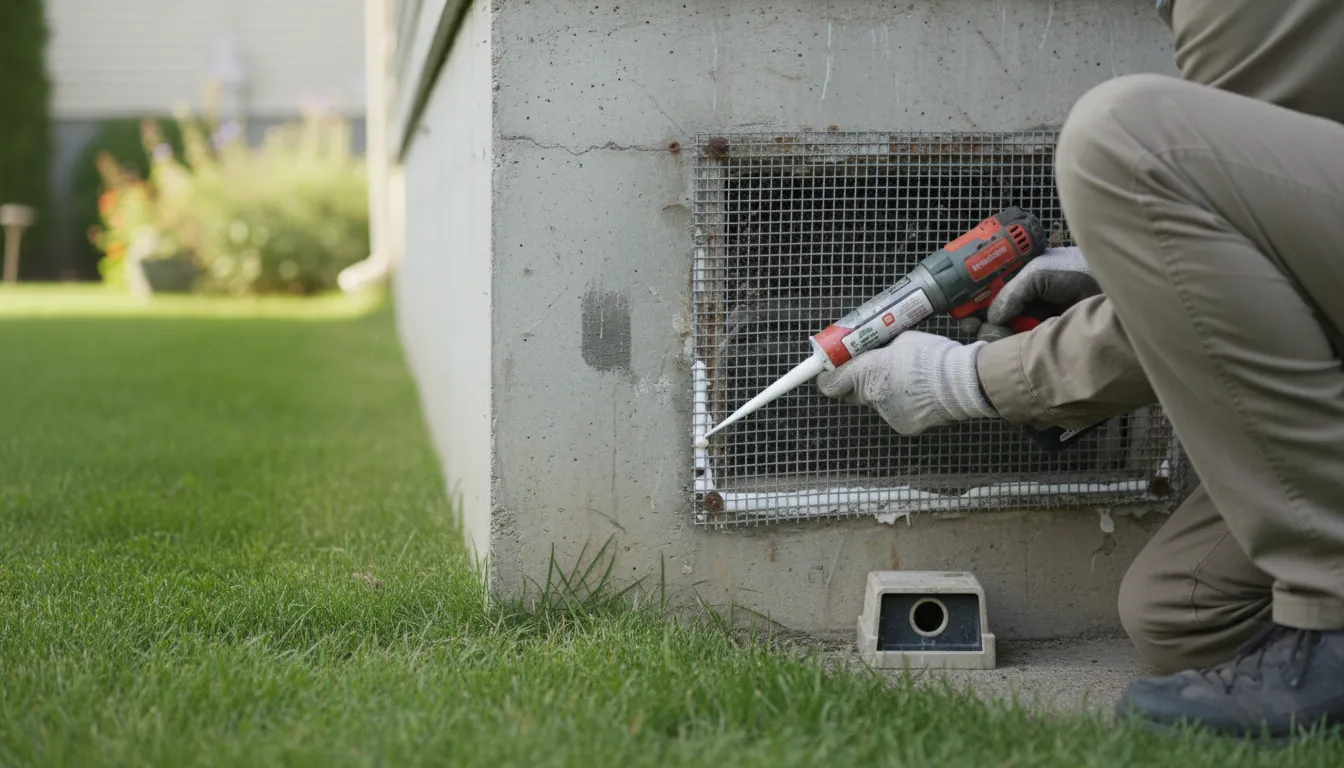
Exclusion, or rodent-proofing, is the most important long-term control method. It involves sealing every potential entry point. Remember, mice can squeeze through a hole the size of a dime, and rats through one the size of a half-dollar.
- Materials: Use durable materials rodents cannot chew through, such as cement, 1/4-inch steel hardware cloth (wire mesh), or copper mesh. For smaller gaps, steel wool packed into openings and covered with expanding foam sealant or caulk is effective 2.
- Key Areas to Seal: Check where utility pipes and wires enter the building, gaps under eaves, in attics, around crawl space vents, and where doors and windows meet their frames. Install or repair weather stripping and door sweeps 3.
Control Methods: Trapping vs. Rodenticides
Once an active infestation is present and entry points are being sealed, population reduction is necessary.
Trapping: The Preferred Method
Trapping is immediate, allows for disposal of carcasses (avoiding odor issues), and poses less risk to non-target animals.
- Snap Traps: These are inexpensive, effective, and recommended for both indoor and outdoor use. Peanut butter makes excellent bait. Place traps perpendicular to walls, with the trigger facing the wall, in areas of high activity.
- Live Traps: These are an option for those opposed to killing rodents. However, captured rodents must be released far from your property (check local regulations), and you must ensure all entry points are sealed first, or new rodents will simply move in 4.
- Placement: Always place traps out of reach of children and pets. For severe infestations, multiple traps are necessary.
Rodenticides (Poison Baits): A Last Resort
The use of poison is generally recommended only as a last resort due to significant risks 5 6.
- Risks: Poisons can be hazardous to children, pets, and wildlife that may eat a poisoned rodent (secondary poisoning). Indoors, rodents may die in inaccessible wall voids, causing persistent foul odors 7 8.
- If Used: Never use loose baits. Always use tamper-resistant bait stations secured in place, and follow all label directions precisely. They are not recommended for indoor use 9 10.
Find the perfect rat & mice control companies for your needs
Get personalized recommendations and expert advice
Professional Rodent Control Services in Oregon
For persistent or large-scale infestations, hiring a licensed professional is often the most efficient and effective solution. Professionals have the expertise, tools, and materials to conduct a comprehensive assessment and implement a robust IPM plan.
What Professionals Offer:
- Detailed Inspection: Identifying all active entry points and nesting areas.
- Customized Treatment Plan: Combining trapping, exclusion, and sanitation advice.
- Expert Exclusion: Using commercial-grade materials to seal your home effectively.
- Follow-up and Monitoring: Ensuring the problem is resolved and doesn't recur.
Cost of Professional Rodent Control in Oregon
Costs vary widely based on the infestation's severity, home size, and required services. Below are typical price ranges for the Portland area, which can serve as a general guide for Oregon 11 12.
| Service/Infestation Level | Typical Cost Range | Notes |
|---|---|---|
| Average Job | $185 - $443 | Covers initial assessment and standard treatment. |
| Small/Mild Infestation | $80 - $397 | May involve basic trapping and minor exclusion. |
| Moderate Infestation | $238 - $556 | Requires a professional plan, more traps, and exclusion work. |
| Large/Severe Infestation | $794 - $6,352+ | Could involve extensive exclusion, multiple visits, or fumigation. |
| One-time Service Visit | $141 - $305 | Initial treatment cost; follow-ups may be needed. |
| Exclusion Services | $159 - $477 | Sealing entry points with durable materials like steel mesh. |
| Quarterly Service Plan | $92 - $287 (per visit) | Ongoing prevention, monitoring, and maintenance. |
Choosing a Professional in Oregon
It is strongly recommended to get more than one written estimate 13. Ensure the company is licensed and bonded with the Oregon Department of Agriculture. Ask about their specific approach to rodent control-a reputable provider will emphasize inspection, exclusion, and IPM principles over simply laying poison.
Yard and Landscape Management for Prevention
Your yard is the first line of defense.
- Trim Vegetation: Keep tree branches trimmed back 6-8 feet from the roof and thin out dense shrubs near the foundation to remove rodent highways and hiding spots 14 15.
- Eliminate Water Sources: Fix leaky faucets and drains, and ensure downspouts direct water away from the foundation.
- Maintain Cleanliness: Keep gardens weeded and free of fallen fruit or vegetables.
Frequently asked questions
Sources
Footnotes
-
Rodent Control - Marion County - https://www.co.marion.or.us/HLT/PH/EHS/vector/Pages/rodent.aspx ↩
-
Rodent Control - Marion County - https://www.co.marion.or.us/HLT/PH/EHS/vector/Pages/rodent.aspx ↩
-
Rodent & Wildlife Infestations: 9 Essential Tips for Portland ... - https://www.ecocarepestcontrol.com/rodent-wildlife-infestations-portland/ ↩
-
Rodent Prevention & Control - Albany, Oregon - https://albanyoregon.gov/rodents ↩
-
Rodent Prevention & Control - Albany, Oregon - https://albanyoregon.gov/rodents ↩
-
Rodent Control in Southern Oregon: How to Keep Mice and ... - https://aone-exterminators.com/2025/10/05/rodent-control-in-southern-oregon-how-to-keep-mice-and-rats-out-of-your-home/ ↩
-
Rats | Multnomah County - https://multco.us/info/rats ↩
-
Options for Dealing With Rodent Infestations | US EPA - https://www.epa.gov/rodenticides/options-dealing-rodent-infestations ↩
-
Rats | Multnomah County - https://multco.us/info/rats ↩
-
Rats | Eugene, OR Website - https://www.eugene-or.gov/3838/Rats ↩
-
How Much Does Rat Exterminator Cost in Portland, OR? | Angi - https://www.angi.com/articles/how-much-does-rat-exterminator-cost/or/portland ↩
-
How Much Does Pest Control Cost in Portland, OR - https://pestextinct.com/portland-or-pest-control/ ↩
-
What You Should Know About Pest Control in Your Home : Pesticide ... - https://www.oregon.gov/oha/ph/healthyenvironments/healthyneighborhoods/pesticides/pages/ctrlhome.aspx ↩
-
How to keep rats away from your home and yard - https://extension.oregonstate.edu/news/how-keep-rats-away-your-home-yard ↩
-
Rat & Rodent Prevention Information | Cottage Grove, OR - https://cottagegroveor.gov/1411/Rat-Rodent-Prevention-Information ↩