Find the Best Termite Inspection Companies for Your Business
No obligation • Fast responses • Nationwide coverage

Why you can trust Pest Crews
Pest Crews is a leading U.S. resource for finding and evaluating residential and commercial pest control services. Our team researches providers, reviews treatment approaches, and organizes unbiased information to help you make informed decisions. Companies cannot pay to change our editorial content or influence how they appear.
Search providers near you
Best Termite Inspection Companies in Tennessee Ranked
A termite inspection is a professional visual examination of a property to detect evidence of wood-destroying insects like termites, carpenter ants, and wood-boring beetles. In Tennessee, this service is critical for protecting your most valuable investment from hidden damage and is often a mandatory step in real estate transactions. This guide will help you understand the process, importance, and typical costs of a termite inspection in the Volunteer State, and how to connect with qualified local professionals to get one.

ClearDefense Pest Control
222 2nd Ave S Suite 1731, Nashville, TN 37201
ClearDefense Pest Control is a pest control company based in Nashville, TN. They provide services for a variety of pests including cockroaches, termites, mosquitoes, spiders, and other household pests. The company offers termite inspections and mosquito control as part of their pest management solutions. ClearDefense Pest Control serves multiple locations beyond Nashville, including West Knoxville, Greenville, Kansas City, and Cincinnati.
Insight Pest Solutions
5000 Linbar Dr #260, Nashville, TN 37211
Insight Pest Solutions provides comprehensive pest control services in Nashville, TN, addressing common household and commercial pests such as cockroaches, ants, rodents, termites, mosquitoes, bees, and wasps. Their approach includes thorough inspections, sealing entry points, and targeted treatments to prevent infestations and protect properties year-round. Established in 1985, the company offers specialized termite inspections and treatments, as well as outdoor mosquito control using environmentally responsible methods. Their service includes ongoing monitoring and seasonal adjustments to maintain pest-free environments.

AAA Termite & Pest Control
Memphis, TN
AAA Termite & Pest Control is a pest control company based in Memphis, TN, specializing in termite inspections and cockroach control for residential and commercial properties. The company has been protecting homes and businesses in Memphis and the Mid-South from termite damage and other pests for more than 50 years. Their services include termite inspections and treatments, as well as cockroach extermination, helping to safeguard health and property.
All-American Pest Control
1585 Mallory Ln STE 201, Brentwood, TN 37027
All-American Pest Control is a family-owned pest control company serving the Nashville, TN area, including Brentwood. With over 60 years of experience since 1961, they offer year-round residential and commercial pest control services targeting a wide range of pests such as termites, ants, rodents, spiders, mosquitoes, and wasps. Their services include termite inspections, mosquito control, rodent removal, and eco-friendly pest management solutions tailored to local pest pressures. They also provide specialized capabilities like the Sentricon® Termite Colony Elimination System and seasonal pest control plans to address changing pest activity throughout the year.
Valley Pest Co.
5005 Macmont Cir, Powell, TN 37849
Valley Pest Co. is a locally owned and family-run pest control company serving Knoxville, TN, and the surrounding Powell area. With over 10 years of experience, they provide pest management for homes and businesses, addressing issues such as ants, roaches, mosquitoes, rodents, spiders, and termites. The company is licensed, certified, and insured, offering services that focus on safe and reliable pest control solutions tailored to the local community.
Why a Termite Inspection is Essential in Tennessee
Tennessee's climate, with its warm, humid summers and mild winters, creates an ideal environment for subterranean termites, which are the most common and destructive species in the state. These pests work silently, often causing significant structural damage long before they are discovered. For homeowners, a routine inspection is a proactive measure to catch infestations early, saving thousands in potential repair costs. For buyers and sellers, a clean inspection report-often called a Wood-Destroying Insect (WDI) report or "termite letter"-is a standard requirement to finalize a mortgage 1 2. Lenders, especially for FHA and VA loans, require this documentation to ensure the property securing the loan is structurally sound 3 4.
What a Licensed Inspector Looks For
A thorough termite inspection in Tennessee is a detailed visual process conducted by a licensed pest control operator. The inspector is trained to identify the subtle signs of infestation that untrained eyes easily miss.
- Mud Tubes: Subterranean termites build pencil-sized tunnels of mud and saliva to travel between their colony in the soil and the wood they are consuming. These are often found on foundation walls, in crawl spaces, or on piers.
- Frass: Drywood termites and certain beetles push out their fecal matter, called frass, from tiny "kick-out" holes in infested wood. This sawdust-like material is a key indicator.
- Damaged Wood: Inspectors will probe accessible wood with a tool, listening for a hollow sound and looking for wood that appears crushed or has a honeycombed interior.
- Swarmers & Wings: The presence of discarded insect wings (from swarmers) or the insects themselves around windowsills, doors, or light fixtures often signals an active colony nearby.
- Moisture Issues: Since termites are attracted to moisture, inspectors look for conditions conducive to infestation, such as wood-to-soil contact, improper drainage, leaking pipes, or poor ventilation in crawl spaces.
The Standard Inspection Process
Understanding what happens during an inspection can set proper expectations. A typical inspection for a single-family home takes one to two hours, depending on the property's size and complexity.
- Exterior Inspection: The inspector examines the home's perimeter, foundation, siding, window and door frames, decks, porches, and any outbuildings. They look for mud tubes, damaged wood, and conditions that attract pests.
- Interior Inspection: Every accessible room is checked. The inspector looks at baseboards, window sills, door frames, and areas under sinks. They tap on wood to check for hollowness.
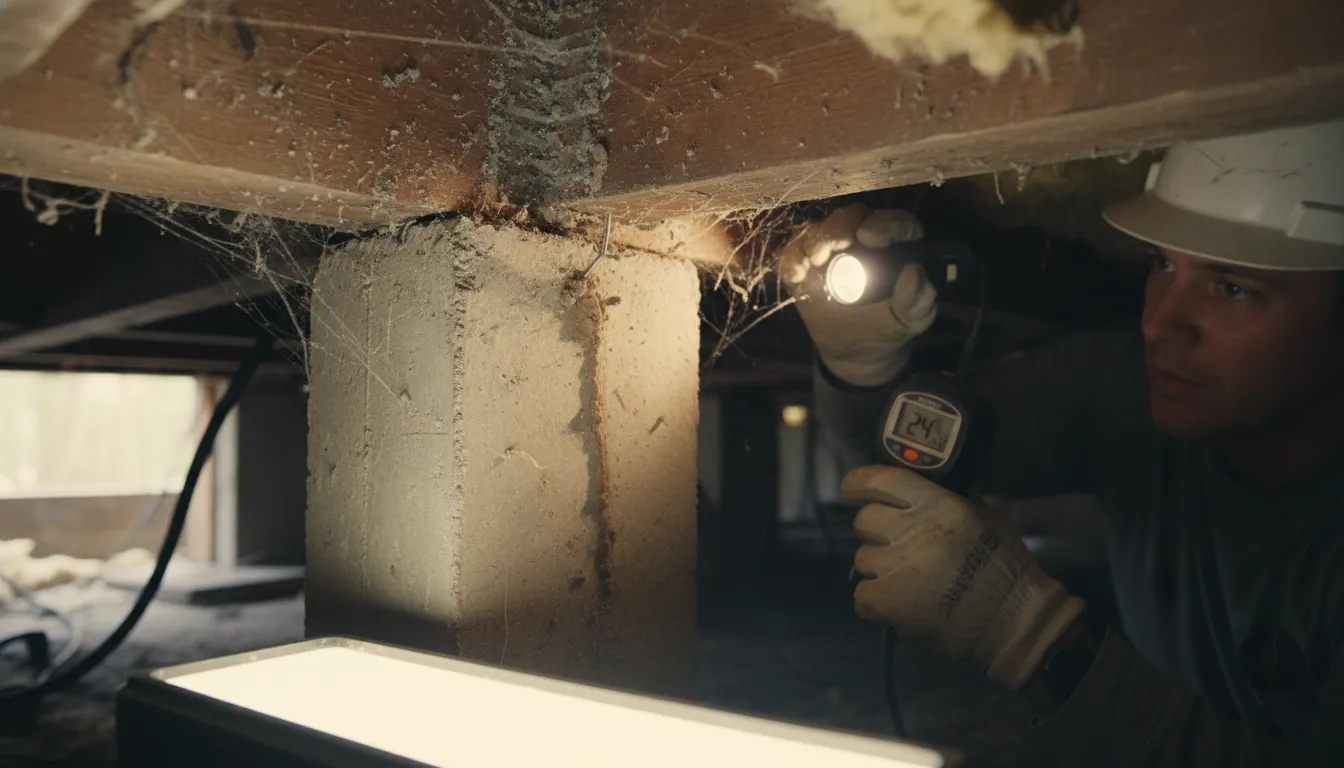
- Sub-Area Inspection: This is a crucial step. The inspector enters crawl spaces and basements to examine floor joists, support posts, and subflooring-prime targets for termites. Attics are also inspected for evidence of drywood termites or carpenter ants.
- Use of Tools: While primarily visual, inspectors often use tools like moisture meters to detect elevated moisture levels within walls or wood, which can indicate a hidden problem. Some may use infrared cameras to identify temperature anomalies behind walls 5 6.
- Inaccessible Areas: It's important to note that inspectors can only examine areas that are physically accessible. Areas blocked by storage, finished walls, or insulation will be noted as "not inspected" on the final report, which is a standard and honest practice.
Understanding the WDI Inspection Report
The formal document generated from the inspection is the Wood-Destroying Insect Report. In Tennessee, licensed inspectors must complete this report on a standard form, often the NPMA-33 form, which is recognized nationwide 7.
Key components of the report include:
- Property Information: Address, diagram of the structure.
- Findings: Clear indication of any visible infestation or damage from specific wood-destroying insects. A "clear" report means no evidence was found.
- Evidence of Previous Treatment: Notation of any visible signs of past termite control measures.
- Recommendations: If an issue is found, the report will detail recommended corrective actions.
- Inspector & Company Credentials: License number and company information.
- Limited Warranty: The report warrants that its findings are accurate for a period of 90 days from the inspection date. This is a critical timeline for real estate transactions.
It's vital to understand that a standard WDI inspection and report do not cover wood-destroying fungi (mold) or rot, though these may be noted as conducive conditions 8.
Find the perfect termite inspection companies for your needs
Get personalized recommendations and expert advice
Cost of Termite Inspections in Tennessee
The price for a termite inspection in Tennessee is generally straightforward and affordable, especially when considering the value it provides. For a standard visual inspection of a typical single-family home, most homeowners can expect to pay between $75 and $150 9 10 11. Several factors can influence this cost:
- Property Size & Type: Larger homes, multi-unit buildings, or properties with extensive outbuildings will cost more to inspect.
- Location: Prices may vary slightly between metropolitan areas like Nashville or Memphis and more rural regions.
- Purpose: A routine inspection may be priced differently than one required for a real estate transaction, though the process is identical.
- Additional Services: If the inspection is bundled with a general home inspection or includes a detailed moisture survey, the total cost will be higher 12.
When comparing quotes, ensure the price includes the complete visual inspection and a formal WDI report. Be wary of "free" inspections, as they may be a sales tactic for unnecessary treatments.
When to Get a Termite Inspection
1. During a Real Estate Transaction: This is the most common trigger. As a buyer, make your offer contingent on a clear WDI report. As a seller, obtaining one beforehand can streamline the sale and prevent last-minute surprises. 2. As Part of Routine Home Maintenance: Experts recommend a professional inspection annually. Catching a termite problem early is the key to minimizing damage and control costs. 3. If You See Signs of Activity: If you notice mud tubes, swarmers, frass, or damaged wood, schedule an inspection immediately. 4. Before Major Renovations: If you're planning to remodel, especially in basements, crawl spaces, or on decks, an inspection can ensure you're not building onto an existing problem.
Choosing a Qualified Inspector in Tennessee
Always verify that the inspector is licensed by the Tennessee Department of Agriculture. You can ask for their license number and confirm it online through the state's website. Choose established, local companies with strong reputations. Read reviews and ask for references. A reputable inspector will be thorough, explain their process, and provide a detailed, easy-to-understand report without using high-pressure sales tactics for treatment. Their primary goal should be accurate assessment.
Frequently asked questions
Sources
Footnotes
-
Termite Letters | Why They Are Important When Buying or Selling Your Home - https://uspest.com/blog/termite-letters-why-they-are-important-when-buying-or-selling-your-home/ ↩
-
Pesticide Consumer Tips - TN.gov - https://www.tn.gov/agriculture/businesses/pesticides/pesticide-consumer-tips.html ↩
-
Pest Inspection Requirements for Mortgages: 2026 Complete Guide - https://www.amerisave.com/learn/pest-inspection-requirements-for-mortgages-complete-guide ↩
-
What's a Termite Letter and when do I Need One? - https://midsouthtrust.com/termites/whats-a-termite-letter-and-when-do-i-need-one/ ↩
-
Termite Inspections - Knoxville - https://npiweb.com/knoxville/services/termite-inspections/ ↩
-
Termite Inspections: Cost and What to Expect - U.S. News Real Estate - https://realestate.usnews.com/real-estate/articles/termite-inspections-cost-and-what-to-expect ↩
-
AN ACT to amend Tennessee Code Annotated, Title 62, Chapter - http://www.capitol.tn.gov/Bills/101/Bill/SB2635.pdf ↩
-
Buyer Beware: Get a WDI Letter Before Buying or Refinancing in ... - https://www.allamericanpestcontrol.com/blog/post/buyer-beware-get-a-wdi-letter-before-buying-or-refinancing-in-east-nashville ↩
-
Tennessee Code § 62-21-202 (2024) - Contents of report - https://law.justia.com/codes/tennessee/title-62/chapter-21/part-2/section-62-21-202/ ↩
-
What Are the Costs of Termite Prevention in Knoxville? - https://www.russellspest.com/termites/prevention/what-are-the-costs-of-termite-prevention/ ↩
-
How Do I Get a WDI Report in East Tennessee? - https://johnsonpestcontrol.com/termites/damage/how-do-i-get-a-wdi-report/ ↩
-
Termite Inspection (WBO Inspection) - https://www.1stchoicehomeinspections.com/termite-inspection-wbo-inspection/ ↩