Find the Best Wildlife Removal Companies for Your Business
No obligation • Fast responses • Nationwide coverage
Why you can trust Pest Crews
Pest Crews is a leading U.S. resource for finding and evaluating residential and commercial pest control services. Our team researches providers, reviews treatment approaches, and organizes unbiased information to help you make informed decisions. Companies cannot pay to change our editorial content or influence how they appear.
Search providers near you
Best Wildlife Removal Companies in Alaska Ranked
Dealing with unwelcome wildlife in Alaska is a unique challenge. The state's vast wilderness and abundant native species mean that encounters with bears, moose, rodents, and birds are common, but the rules for handling them are strict. Wildlife removal here is a highly regulated activity focused on coexistence and conservation. This resource helps you understand Alaska's specific laws, the importance of professional intervention, and how to connect with licensed experts who can resolve conflicts safely and legally.
Alaska Affordable Pest
Anchorage, AK
Alaska Affordable Pest provides pest control and wildlife removal services in Anchorage, AK, and surrounding areas including Eagle River, Wasilla, Palmer, and Girdwood. They offer treatments for ants, bed bugs, rodents, bees, wasps, and other pests, focusing on long-term prevention and humane wildlife removal. The company is licensed and insured, with capabilities in rodent control and organic pest management. They serve both residential and commercial clients in the Anchorage region.
Varmint Gone Anchorage
9952 W Demar Ave, Wasilla, AK 99623
Varmint Gone Anchorage provides wildlife and pest control services in Anchorage, AK, including bat, rodent, and squirrel removal for both commercial and residential properties. The company is known for its expertise in permanent removal solutions and offers services throughout Anchorage, the Mat-Su Borough, Kenai Peninsula, and remote Alaskan areas, including fly-in service for hard-to-reach communities. With 34 years of experience, Varmint Gone Anchorage is a NWCOA Certified Compliant Wildlife Control Operator and offers a one-year warranty on all repairs and exclusion work. The founder also provides wildlife rescue and transport services to rehabilitation facilities across Alaska.
Understanding Alaska's Wildlife Protection Laws
In Alaska, virtually all native mammals, birds, and reptiles are classified as "game" and are protected under state law 1. This foundational principle means you cannot simply trap, relocate, or lethally remove an animal causing a nuisance on your property. Specific federal laws add additional layers of protection for species like migratory birds (Migratory Bird Treaty Act), bald eagles, marine mammals (Marine Mammal Protection Act), and threatened or endangered species (Endangered Species Act) 2. It is also illegal to possess live game animals, such as bears or deer, without a permit 3.
The central authority for managing human-wildlife conflict is the Alaska Department of Fish and Game (ADF&G). In most cases, a permit from ADF&G is required to systematically harass (haze), capture, handle, transport, or lethally remove nuisance native wildlife 4. This applies to both homeowners and businesses. The state emphasizes non-lethal, preventative measures first, as actions like feeding wildlife or improper garbage disposal are illegal and often create the nuisance problem.
When Can You Act Without a Permit? Defense of Life or Property
Alaska law provides a narrow exception for immediate threats. A person may take game in defense of life or property without a prior permit, but only under strict conditions:
- All other practical means to protect life and property have been exhausted (e.g., using electric fences, securing attractants, going inside).
- The necessity was not caused by attracting the animal through negligence, such as improper garbage storage or feeding pets outdoors.
If you must lethally remove an animal under these circumstances, you are legally obligated to immediately notify ADF&G or the Alaska Wildlife Troopers and surrender specific animal parts (like a bear hide and skull) within a prescribed period 5 6.
The Role of Licensed Wildlife Control Professionals
Given the complex legal landscape, hiring a professional is often the safest and most compliant course of action. Businesses or individuals offering animal control services for others must hold a Nuisance Wild Animal Control License from ADF&G. These licensed operators are trained in legal methods, understand permit requirements, and are obligated to:
- Submit detailed quarterly reports to ADF&G on all animals handled.
- Ensure all practical non-lethal means are exhausted before any lethal control 7.
A professional will start with a thorough inspection to identify the species, entry points, and attractants. Their approach typically follows an integrated process of removal, exclusion, and cleanup.
Find the perfect wildlife removal companies for your needs
Get personalized recommendations and expert advice
Common Wildlife Issues and Professional Solutions
Bears
Bears are a top concern. Prevention is paramount: use bear-resistant containers, never leave pet food outside, and clean grills thoroughly. If a bear becomes a habitual nuisance, only licensed professionals or ADF&G personnel should intervene, which may involve hazing or, as a last resort, relocation or lethal removal under permit.
Moose
Moose can be aggressive, especially cows with calves. The primary strategy is to give them space and wait for them to move on. Fencing can protect gardens. Licensed professionals generally do not "remove" moose due to their size and danger; persistent problems are typically handled by ADF&G.
Small Mammals (Squirrels, Porcupines, Rodents)
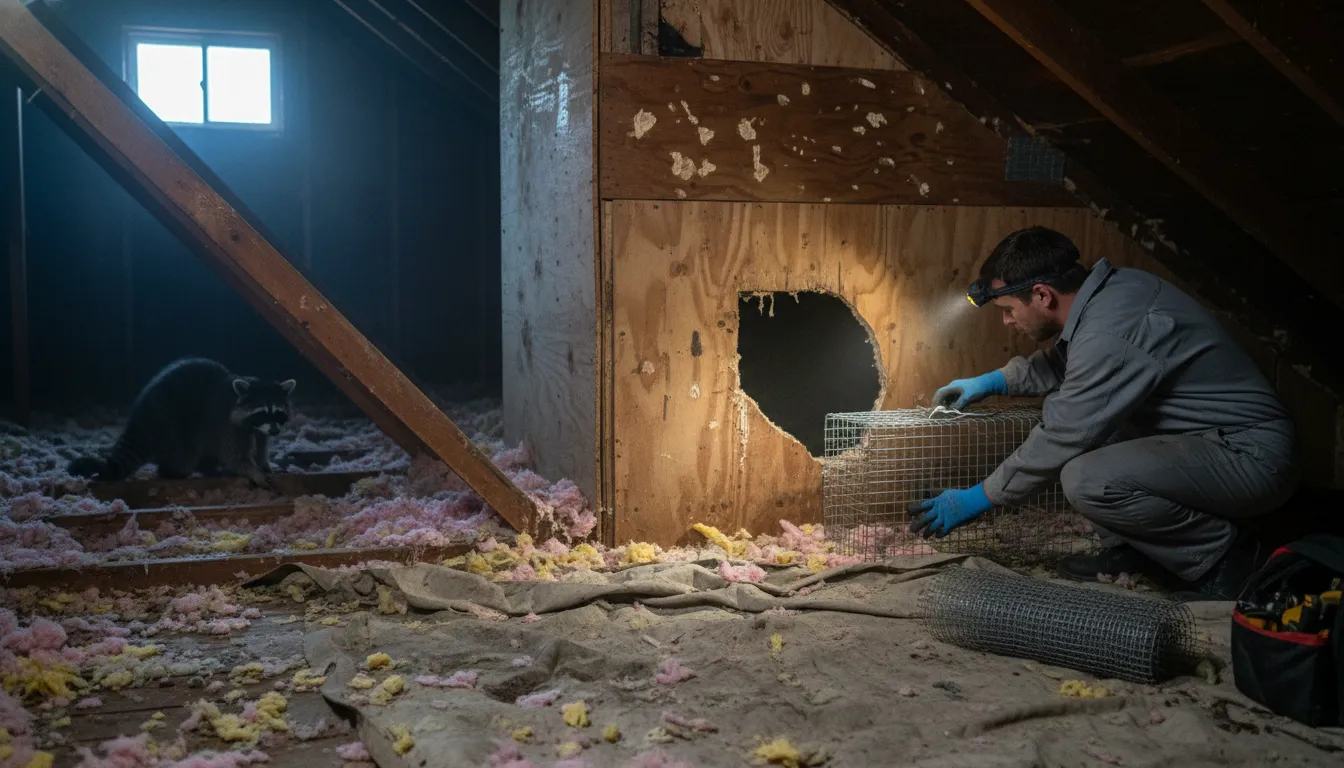
These animals often seek shelter in attics, crawl spaces, and under decks. Professionals will use live traps or one-way exclusion doors to remove them, followed by sealing all potential entry points with durable materials like steel mesh-a critical step to prevent recurrence.
Birds and Bats
Remember, most birds are federally protected. Professionals can install exclusion devices like netting or spikes after nesting season ends and safely remove bats, often focusing on creating alternative roosting sites.
What to Expect: Costs of Wildlife Removal in Alaska
Costs for professional wildlife control vary widely based on the animal, location, extent of infestation, and required methods 8 9 10 11. Below is a general breakdown:
- Initial Inspection/Service Call: Many companies charge a flat fee for assessment, often ranging from $150 to $300+.
- Trapping & Removal: This is usually charged per animal or per service visit. Costs can range from $50 to $200+ per animal, depending on the species and trapping difficulty 12 13 14.
- Exclusion & Repairs: This is often the most significant cost but is essential for a permanent solution. Sealing all entry points and repairing damage can cost several hundred to several thousand dollars 15.
- Emergency Services: For an immediate dangerous threat (e.g., a bear inside a home), call 911. Law enforcement and ADF&G handle such public safety incidents.
Preventative Measures: Your First Line of Defense
Alaska law encourages and often requires preventative action. Securing attractants isn't just good practice-it's a legal responsibility that can prevent conflicts before they start 16 17.
- Garbage: Use bear-resistant containers or store cans in a secure shed.
- Pet Food: Feed pets indoors and store food inside.
- Bird Feeders: Take them down from April through November.
- Home Maintenance: Seal cracks in foundations, install chimney caps, and repair holes in siding or roofing vents.
- Fencing: Use electric fencing to protect gardens, livestock, and compost piles.
The Professional Process: From Inspection to Exclusion
- Inspection & Assessment: A licensed professional will identify the pest species, locate entry points, and assess damage.
- Permitting: They will obtain any necessary ADF&G permits for the planned removal actions.
- Removal: Using approved, humane methods like live traps or exclusion devices, the animals are removed from the structure.
- Exclusion & Repair: This critical step involves sealing all entry points with durable materials like steel flashing or hardware cloth to prevent re-entry.
- Cleanup & Sanitation: Professionals may offer to clean contaminated insulation and droppings, which is important for health and odor removal.
- Monitoring & Follow-up: A good service will follow up to ensure the problem is resolved and provide advice for long-term prevention.
Frequently asked questions
Sources
Footnotes
-
Alaska Statutes | Animal Legal & Historical Center - https://www.animallaw.info/statutes/us/alaska ↩
-
Environmental Laws and Regulations | AK Dept. of ... - https://dec.alaska.gov/spar/csp/faq/env-laws/ ↩
-
Exotic Cats and Pet Bears, Alaska Department of Fish and Game - https://www.adfg.alaska.gov/index.cfm?adfg=wildlifenews.view_article&articles_id=162 ↩
-
Transport and Possession Permits, Licenses and ... - https://www.adfg.alaska.gov/index.cfm?adfg=otherlicense.main ↩
-
Fish & Wildlife Habitat - Alaska Division of Mining, Land, and Water - https://dnr.alaska.gov/mlw/landsales/info/fish-wildlife-habitat/ ↩
-
Licenses & Permits, Alaska Department of Fish and Game - https://www.adfg.alaska.gov/index.cfm?adfg=otherlicense.protecting ↩
-
5 AAC 92.420 - Taking nuisance wildlife | State Regulations - https://www.law.cornell.edu/regulations/alaska/5-AAC-92.420 ↩
-
Wildlife Control - MMPC - https://mandmpestcontrol.com/services/wildlife-control/ ↩
-
Trapping Program - https://hogarthspestcontrol.com/services/trapping-services/ ↩
-
Tri State Wildlife Exclusion - https://wildlifehelp.org/profile/300 ↩
-
Lewis Pest Control & Wildlife Removal - https://www.lewispest.com/wildlife-removal/ ↩
-
Anchorage Wildlife Animal Control - Pest Removal Trappers - http://www.wildlifeanimalcontrol.com/Anchorage.html ↩
-
How much is pest control for squirrels? - https://www.thepestcontrolguy.ca/how-much-is-pest-control-for-squirrels/ ↩
-
Wildlife Control Pricing Guide - https://www.michiganwildlifesolutions.com/about/wildlife-control-pricing/ ↩
-
FAQs - Animal Eviction - https://tlcwildlifemanagement.com/faqs/ ↩
-
Wildlife Safety - Alaska Department of Fish and Game - https://www.adfg.alaska.gov/index.cfm?adfg=wildlifenews.view_article&articles_id=909 ↩
-
Wildlife Safety - Alaska Department of Fish and Game - https://www.adfg.alaska.gov/index.cfm?adfg=wildlifenews.view_article&articles_id=909 ↩