Find the Best Wildlife Removal Companies for Your Business
No obligation • Fast responses • Nationwide coverage

Why you can trust Pest Crews
Pest Crews is a leading U.S. resource for finding and evaluating residential and commercial pest control services. Our team researches providers, reviews treatment approaches, and organizes unbiased information to help you make informed decisions. Companies cannot pay to change our editorial content or influence how they appear.
Search providers near you
Best Wildlife Removal Companies in Delaware Ranked
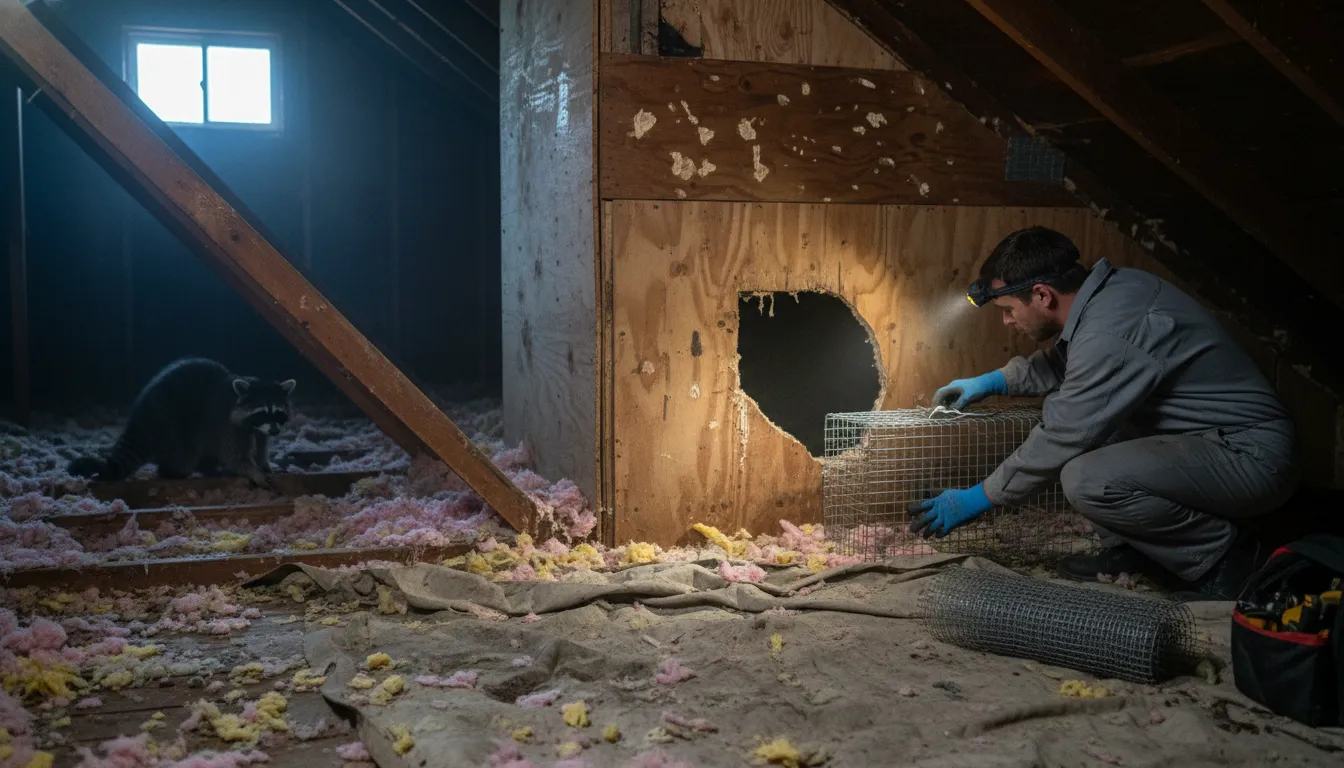
When wildlife like raccoons, squirrels, or bats move into your attic, chimney, or yard, it can quickly escalate from a nuisance to a serious problem. These uninvited guests can cause significant property damage, create health hazards, and disrupt your peace of mind. Understanding your options for wildlife control in Delaware is essential, as state laws strictly regulate which animals can be removed and by what methods. This guide provides a clear overview of Delaware's wildlife removal regulations, typical processes, and costs, helping you make an informed decision to resolve your situation safely and legally.
Understanding Delaware's Wildlife Regulations
Delaware law distinguishes between protected and unprotected wildlife, which directly dictates whether a homeowner can act independently or must hire a professional. Most native species in the state are protected by law 1. This means you cannot harm, trap, or relocate them without specific authorization from the Delaware Division of Fish and Wildlife (DNREC). Attempting to handle protected species yourself could result in legal penalties.
However, the state designates a few common nuisance animals as unprotected in specific contexts. According to Delaware regulations, gray squirrels, raccoons, rabbits, and opossums can be controlled (including lethally) on your own property without a permit if they are causing damage to a residential or commercial structure. This exception is crucial for homeowners facing immediate threats from these particular species.
When You Need a Permit for Animal Removal
Navigating permit requirements is a critical step in the wildlife removal process. Knowing when a permit is mandatory can save you time and ensure you remain compliant with state law.
Situations Requiring a Permit:
- Removing Protected Species: Any action against protected wildlife, such as deer, foxes, beavers, mink, or federally listed endangered species like the Bog Turtle, requires a permit from DNREC.
- Substantial Property Damage: If protected wildlife is causing significant damage to your property, you or a tenant can apply to DNREC for a depredation permit to lethally remove the animals.
- Commercial Removal Activities: Anyone conducting wildlife removal for payment must be a registered Nuisance Wildlife Control Operator (NWCO) with a valid permit from DNREC 2.
- Using Certain Trap Types: The use of foothold traps or any method outside of approved live trapping for damage control typically requires a depredation permit 3.
Situations Not Requiring a Permit: As noted, homeowners do not need a permit to remove gray squirrels, raccoons, rabbits, or opossums causing damage, provided they use only box or cage-type live traps and the action occurs outside of established trapping seasons 4. This is a key allowance for DIY efforts, but it comes with important restrictions on relocation, which we will cover next.
Approved Methods for DIY Wildlife Control
If you choose to address an issue with an unprotected species yourself, Delaware law specifies the methods you must use. The only traps allowed for use without a depredation permit are box or cage live traps (e.g., Havahart traps). These are considered the most humane option for capturing animals without injury.
Once an animal is trapped, you face strict rules on relocation. You cannot release trapped wildlife on any state-owned or public land5. The only legal option is to transport the animal to private property, but you must obtain written permission from the landowner before doing so. Releasing an animal on another person's property without permission is illegal. This regulation is designed to prevent the spread of disease and the creation of a nuisance problem for someone else.
It is also your responsibility to check traps at least once every 24 hours. If an animal is injured or you need to euthanize it, you must do so in a humane manner and dispose of the carcass properly-not above ground-within 24 hours. These responsibilities make DIY trapping a significant commitment.
The Role of Professional Nuisance Wildlife Control Operators (NWCOs)
For many homeowners and businesses, hiring a licensed Nuisance Wildlife Control Operator is the most practical and legally sound solution. NWCOs are professionals certified by the state to handle complex or sensitive wildlife situations.
These operators must complete a certification program, register with the DNREC Division of Fish and Wildlife, and carry their permit while on the job 6 7. They are knowledgeable about state laws, animal behavior, and humane removal techniques. A professional NWCO can legally handle protected species if they have the appropriate permits, and they are equipped to deal with animals in difficult-to-access areas like attics, wall voids, or chimneys.
Their services often extend beyond simple trapping. A comprehensive wildlife control job includes:
- Inspection: Identifying the species, entry points, and extent of the infestation.
- Humane Removal: Using specialized techniques to remove all animals.
- Exclusion: Sealing entry points to prevent re-entry. This is a critical step often overlooked in DIY attempts.
- Clean-up and Sanitation: Removing contaminated insulation and droppings to eliminate health risks.
- Restoration: Repairing damage caused by the animals, such as chewed wires, torn ductwork, or damaged siding.
Find the perfect wildlife removal companies for your needs
Get personalized recommendations and expert advice
Protected, Regulated, and Invasive Species in Delaware
Knowing which animals are off-limits is crucial. Delaware's wildlife is managed through a system of protections and regulated hunting seasons.
- Protected/Regulated Species: Many animals have specific seasons when they can be hunted or trapped. These include deer, red and gray fox, beavers, mink, muskrats, otters, and certain frogs and turtles 8 9. Outside of these seasons, they are protected and cannot be taken without a permit.
- Endangered & Threatened Species: Federally and state-listed species receive the highest level of protection. It is illegal to harm, harass, or possess them. This list includes the Delmarva Fox Squirrel, Bog Turtle, and various sea turtles that nest on Delaware beaches 10 11 12.
- Invasive Species: Some non-native species are not protected. For example, mute swans are considered an invasive exotic species and may be taken during legal waterfowl hunting seasons 13.
What Does Wildlife Removal Cost in Delaware?
The cost of professional wildlife removal in Delaware is not one-size-fits-all. It varies based on the animal species, the location and severity of the problem, and the required repairs.
- Basic Trapping and Removal: For a single animal in an accessible location like a yard, you might pay a flat fee ranging from $150 to $250 14.
- Small to Medium Jobs: Simple removal jobs often start at around $100 and up. More involved situations, like removing a family of raccoons from an attic with minor exclusion work, can range from $300 to $500 15.
- Large or Complex Jobs: Extensive infestations that cause significant damage or require multiple service trips, complex exclusion, and restoration work can easily cost $500 and up, sometimes reaching into the thousands 16 17.
The most accurate way to determine cost is to get a site-specific inspection and quote from a licensed Delaware NWCO 18. While price is a factor, the expertise, guarantee on exclusion work, and legal compliance a professional provides are valuable considerations.
The Professional Removal Process: What to Expect
When you hire a professional, a structured process ensures the problem is solved completely. It typically begins with a thorough inspection of your property to identify all active entry points, damage, and the species involved. The operator will then develop a custom plan, which may involve live trapping, one-way exclusion doors, or hands-on removal.
After all animals are removed, the critical step of exclusion begins. This involves sealing all potential entry points with durable materials like steel mesh, hardware cloth, or chimney caps. Without proper exclusion, new animals will simply move into the now-vacant space. Finally, many companies offer cleaning and repair services to restore your property to a safe and sanitary condition, addressing hazards like urine-soaked insulation or chewed electrical wiring.
Frequently asked questions
Sources
Footnotes
-
Wildlife Trafficking - https://www.primelawfirm.com/wildlife-trafficking ↩
-
Nuisance Wildlife Control Permits - Business First Steps - https://firststeps.delaware.gov/nuisance_wildlife/ ↩
-
USDA Wildlife Services Post FY19 Data Reports - https://content.govdelivery.com/accounts/USDAAPHIS/bulletins/2a4a409 ↩
-
title 7 - Delaware Code - https://delcode.delaware.gov/title7/c001/index.html ↩
-
7 Del. Admin. Code § 3900-10.0 - Nuisance Wildlife - https://www.law.cornell.edu/regulations/delaware/7-Del-Admin-Code-SS-3900-10.0 ↩
-
7 Del. Admin. Code § 3900-10.0 - Nuisance Wildlife - https://www.law.cornell.edu/regulations/delaware/7-Del-Admin-Code-SS-3900-10.0 ↩
-
Delaware | Training Information for Wildlife Control Operators - https://nwco.net/states/states-a-h/delaware/ ↩
-
3900 Wildlife - Delaware Regulations - https://regulations.delaware.gov/register/january2026/final/29%20DE%20Reg%20621%2001-01-26 ↩
-
Delaware.gov - Finalized Revised Amendments - https://documents.dnrec.delaware.gov/Admin/Hearings/2023-R-F-0013/Finalized-Revised-Amendments.pdf ↩
-
7 Del. Admin. Code § 3916-16.0 - Endangered Species - https://www.law.cornell.edu/regulations/delaware/7-Del-Admin-Code-SS-3916-16.0 ↩
-
title 7 - Delaware Code Online - https://delcode.delaware.gov/title7/c007/sc06/ ↩
-
Endangered Species - Protections and Prohibited Actions - https://www.fishwildlife.org/law-research-library/law-categories/endangered-species/endangered-species-protections-and-prohibited-actions-delaware ↩
-
corrected - Delaware Regulations - https://archive.regulations.delaware.gov/register/november2023/proposed/27%20DE%20Reg%20318%2011-01-23.pdf ↩
-
Prices for Delaware Wildlife Pest Control Animal Trapping - http://www.aaanimalcontrol.com/professional-trapper/prices/OH-Delaware-prices.htm ↩
-
Milford Wildlife Removal, Pest Animal Control DE - http://www.wildlife-removal.com/city/DE-Milford.htm ↩
-
Prices for Delaware Pest Wildlife Control - http://www.delawarepestwildlife.com/prices.html ↩
-
How Much Does Wildlife Removal Cost? [2025 Data] - Angie's List - https://www.angi.com/articles/what-cost-animal-removal.htm ↩
-
When Wildlife Cause Problems - DNREC - Delaware.gov - https://dnrec.delaware.gov/fish-wildlife/conservation/wildlife-problems/ ↩