Find the Best Wildlife Removal Companies for Your Business
No obligation • Fast responses • Nationwide coverage

Why you can trust Pest Crews
Pest Crews is a leading U.S. resource for finding and evaluating residential and commercial pest control services. Our team researches providers, reviews treatment approaches, and organizes unbiased information to help you make informed decisions. Companies cannot pay to change our editorial content or influence how they appear.
Search providers near you
Best Wildlife Removal Companies in Maine Ranked
Discovering an uninvited animal in your home or on your property can be unsettling. Wildlife removal in Maine involves the humane and legal eviction of nuisance animals like squirrels, raccoons, and bats, followed by measures to prevent future issues. This service is crucial for protecting your property and ensuring the safety of both your family and the animals, which are governed by strict state and federal laws. Understanding your options and local regulations is the first step toward resolving a wildlife conflict effectively.
Understanding Maine's Wildlife Regulations
Before taking any action, it's essential to know the legal framework. Maine's wildlife is protected by a combination of state statutes and federal laws, designed to manage populations humanely and conserve species.
- Protected Species: Certain animals have stringent protections. Federally protected species in Maine include the Canada Lynx, Piping Plover, Roseate Tern, and the Northern Long-Eared Bat. It is illegal to harm, harass, or possess these animals without specific federal permits.
- General State Rules: As a homeowner, you generally cannot keep, relocate, or possess most wild animals without a license from the Maine Department of Inland Fisheries & Wildlife (IFW) 1. This includes common nuisance animals.
- Permits for Homeowners: While scientific collection or commercial permits are for researchers and professionals, IFW provides clear guidelines for homeowners dealing with conflicts 2. For typical nuisance removal, you may not need your own permit if you follow IFW's approved methods, but you are prohibited from exporting, selling, or possessing the wildlife afterward 3.
Common Nuisance Wildlife in Maine
Different animals present unique challenges and are subject to specific rules. Knowing which creature you're dealing with guides the proper response.
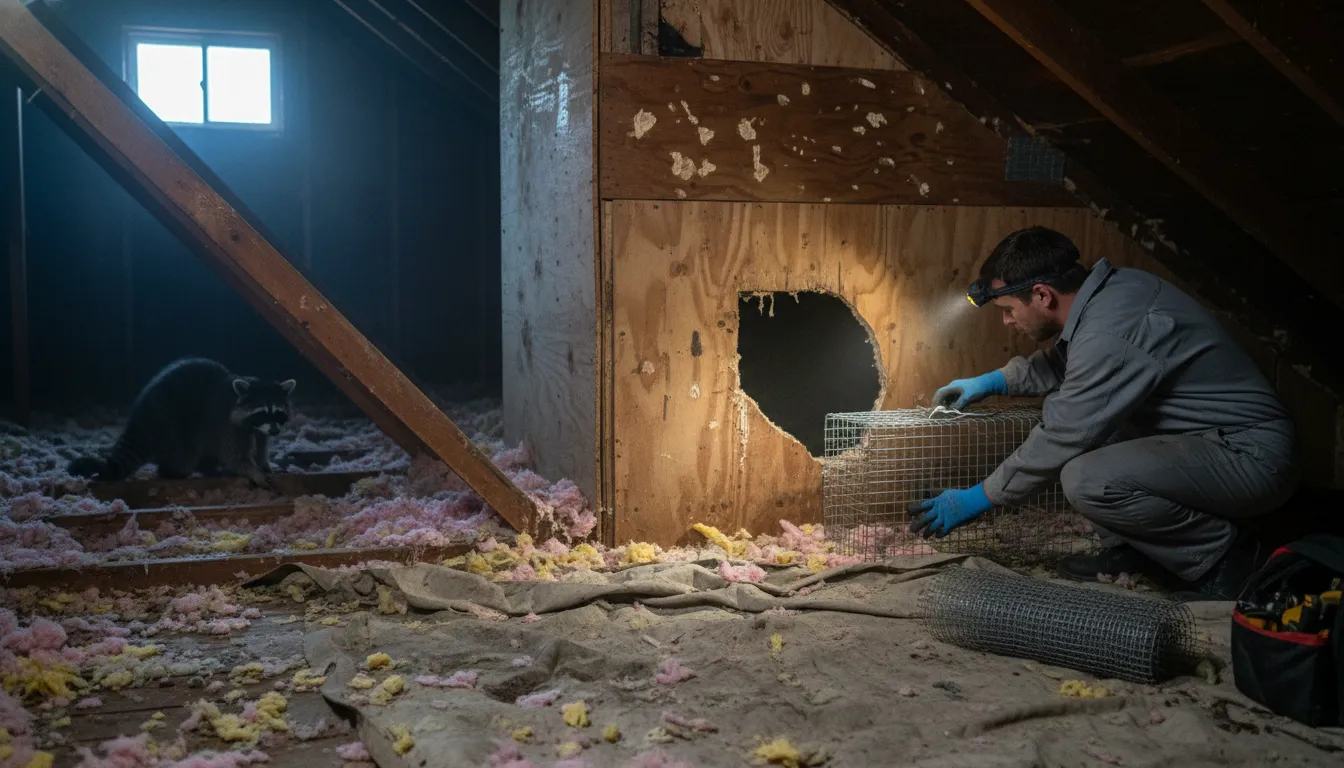
- Raccoons & Squirrels: These are frequent attic invaders seeking shelter. They can cause significant damage by tearing insulation, chewing wires, and contaminating spaces. Maine IFW provides specific guidance for dealing with these mammals.
- Bats: Bats often roost in attics or walls. It's important to note that the Northern Long-Eared Bat is federally protected. Even for non-protected species, exclusion must be done carefully, often outside of the maternity season (typically May through July), to avoid trapping flightless young inside.
- Deer and Coyotes: For deer causing damage to orchards or landscapes, and for coyotes, the department has specific nuisance control provisions and may take action in certain situations.
- Birds: Most birds are protected under federal law. However, species like house sparrows, European starlings, and pigeons are exceptions and are not protected, allowing for more direct control measures if they become a nuisance 4.
The Wildlife Removal Process: A Step-by-Step Guide
Effective and humane animal control follows a logical sequence: identification, eviction, exclusion, and cleanup.
1. Inspection and Identification
The first step is a thorough inspection to identify the animal, locate its entry points, and assess the extent of the problem. Professionals look for signs like droppings, tracks, grease marks, and damage. This critical step typically costs between $100 and $300.
2. Humane Eviction and Harassment
Once identified, the goal is to encourage the animal to leave on its own.
- Harassment Techniques: Using bright lights, loud noises (like a radio), or safe repellents can make an attic or crawlspace undesirable, prompting animals to vacate.
- Consideration for Young: Always check for the presence of young animals. If babies are present, eviction should often be delayed until they are mobile and can leave with the adult, to prevent orphans from dying inside your walls.
- Professional Trapping: For persistent animals, live trapping may be necessary. In Maine, state law requires that traps be checked at least once every 24 hours 5. This is a task best left to licensed professionals who understand the legal and ethical requirements.
3. Exclusion and Prevention
Removing the animal is only half the battle. Preventing a recurrence is key.
- Sealing Entry Points: After confirming all animals are out, every potential entry hole must be sealed. This includes gaps in roof vents, soffits, chimneys, and foundations. Use durable materials like hardware cloth, sheet metal, or commercial chimney caps 6.
- Habitat Modification: Trim tree branches away from your roof, secure trash cans with locking lids, remove pet food, and clean up fallen birdseed to make your property less attractive to wildlife.
4. Cleanup and Sanitation
After exclusion, affected areas need to be cleaned and sanitized. Droppings, urine, and nesting materials can pose health risks and attract new pests. Professional services often include decontamination, odor removal, and insulation replacement.
Find the perfect wildlife removal companies for your needs
Get personalized recommendations and expert advice
When to Call a Professional Wildlife Removal Service
While some minor issues can be DIY projects, many situations warrant calling a licensed expert.
- The animal is potentially dangerous (e.g., a cornered raccoon, a bat colony).
- You suspect a protected species is involved.
- The infestation is in a hard-to-reach area like inside walls or a chimney.
- You are unsure if young animals are present.
- The problem is recurring despite your efforts.
- Extensive cleanup or repair is needed.
Licensed professionals have the experience, tools, and knowledge of Maine's complex wildlife laws to resolve the issue efficiently, humanely, and legally. For complex jobs like full attic removals, costs can range from $500 to $1,500 or more, depending on the extent of the infestation and necessary repairs 7.
Cost of Wildlife Removal in Maine
Costs can vary widely based on the animal, the location of the infestation, and the required services. Here's a general breakdown based on industry averages:
- Initial Inspection: $100 - $300
- General Removal (e.g., trapping a single animal): $200 - $600
- Complex Removal (e.g., attic infestation, chimney cap installation): $500 - $1,500+
Always get a detailed, written estimate from any service provider before work begins.
Key Takeaways for Maine Homeowners
- Always Check Regulations First: Before taking action, consult the Maine IFW website for the most current guidelines on your specific nuisance animal 8 9. Laws are strict and can carry significant penalties.
- Prevention is Paramount: Securing your home against entry is the most effective and cost-efficient long-term strategy for wildlife control.
- Humane Methods are Required: Maine law emphasizes humane treatment. This includes daily trap checks and considering the welfare of young animals.
- Professional Help is Often Best: For anything beyond a simple, one-time eviction, a licensed wildlife removal service ensures the job is done safely, completely, and in compliance with all state and federal laws.
Frequently asked questions
Sources
Footnotes
-
Title 12, §12152: Permit to possess wildlife in captivity - https://legislature.maine.gov/statutes/12/title12sec12152.html ↩
-
PUBLIC Law, Chapter 374 on - Session - Maine Legislature - https://www.mainelegislature.org/legis/bills/bills_127th/chapters/PUBLIC374.asp ↩
-
Endangered Species - Permitting Process - Maine - https://www.fishwildlife.org/law-research-library/law-categories/endangered-species/endangered-species-permitting-process-maine ↩
-
Title 12, §12404: Specific animals - Maine Legislature - https://www.mainelegislature.org/legis/statutes/12/title12sec12404.html ↩
-
Maine Nuisance Wildlife Removal | Fast & Humane Control - https://thibodeauoutdooradventures.com/maine-guided-trapping/maine-nuisance-wildlife-removal/ ↩
-
Evicting Animals From Buildings - Maine.gov - https://www.maine.gov/ifw/fish-wildlife/wildlife/living-with-wildlife/avoid-resolve-conflict/evicting-animals.html ↩
-
How Much Does Animal & Wildlife Removal Cost? (2026) - https://homeguide.com/costs/animal-and-wildlife-removal-costs ↩
-
Maine Laws Governing Wildlife - https://www.maine.gov/ifw/fish-wildlife/wildlife/living-with-wildlife/avoid-resolve-conflict/laws.html ↩
-
Dealing with Nuisance Wildlife - Maine.gov - https://www.maine.gov/dacf/php/gotpests/othercritters/factsheets/nuisance-wildlife-md.pdf ↩