Find the Best Wildlife Removal Companies for Your Business
No obligation • Fast responses • Nationwide coverage

Why you can trust Pest Crews
Pest Crews is a leading U.S. resource for finding and evaluating residential and commercial pest control services. Our team researches providers, reviews treatment approaches, and organizes unbiased information to help you make informed decisions. Companies cannot pay to change our editorial content or influence how they appear.
Search providers near you
Best Wildlife Removal Companies in New Hampshire Ranked
When wildlife like raccoons, bats, or squirrels move into your attic, chimney, or under your deck, it's more than a nuisance-it can cause significant property damage and pose health risks. In New Hampshire, addressing these situations requires a clear understanding of state and federal laws designed to protect both people and animals. This guide explains the legal framework for wildlife control, outlines when you need a professional, and provides practical steps for resolving conflicts with New Hampshire's native fauna safely and humanely.
Understanding New Hampshire's Wildlife Laws
Navigating wildlife issues in the Granite State starts with knowing the rules. New Hampshire classifies animals into different categories, each with specific protections and regulations governing their removal.
Nuisance Wildlife includes common species that frequently conflict with human habitats, such as raccoons, skunks, woodchucks (groundhogs), porcupines, coyotes, and certain bats. For these animals, removal is often permitted, but it is regulated. Homeowners have more flexibility to address problems on their own property during the legal hunting or trapping season for that species. However, if the animal is causing damage outside of that season, you typically need to hire a licensed professional known as a Wildlife Control Operator (WCO).
Protected Species are subject to strict state and federal laws. This category includes:
- Migratory Birds: All native birds, their nests, and eggs are protected under the federal Migratory Bird Treaty Act. It is illegal to harm, possess, or disturb active nests without a special federal permit 1.
- Endangered and Threatened Species: Animals like the New England cottontail rabbit or certain bat species are protected under the New Hampshire Endangered Species Conservation Act. "Taking" (which includes harming, harassing, or killing) these animals is prohibited without specific permits from NH Fish and Game 2 3.
Knowing whether you're dealing with a common nuisance animal or a protected species is the critical first step in choosing a legal and effective response.
When You Need a Professional Wildlife Control Operator
For many wildlife conflicts, especially those involving structural entry or potential health risks, hiring a licensed Wildlife Control Operator (WCO) is the safest and most legally sound option. New Hampshire issues two levels of WCO licenses.
- Level I WCO: This license allows an individual to trap furbearing animals, woodchucks, coyotes, and porcupines outside of the regular trapping season. To obtain this license, the individual must also hold a valid New Hampshire trapping license. Level I operators are typically suited for specific, on-season trapping scenarios.
- Level II WCO: This is the standard commercial license. Level II operators have completed required training and certification. They can handle a broader range of nuisance wildlife situations for a fee and are authorized to dispatch animals when necessary. They are also required to report the number of animals taken annually to NH Fish and Game 4 5.
A professional WCO will not only remove the animal but, more importantly, identify and seal entry points to prevent future intrusions-a process known as exclusion. They are also trained in humane methods and understand the complex regulations, such as the rules against relocating wildlife, which can spread disease and is often illegal without landowner permission.
Find the perfect wildlife removal companies for your needs
Get personalized recommendations and expert advice
Common Wildlife Issues and Solutions in New Hampshire
Bats in Attics
Several bat species in New Hampshire are protected, and some are considered threatened. However, bats found in human living spaces or areas with livestock can be removed year-round by a licensed WCO 6. The primary method is exclusion, which involves installing one-way doors that allow bats to leave but not re-enter, after ensuring no flightless young are present. This work is delicate and best left to professionals familiar with both bat biology and exclusion techniques.
Raccoons, Squirrels, and Rodents
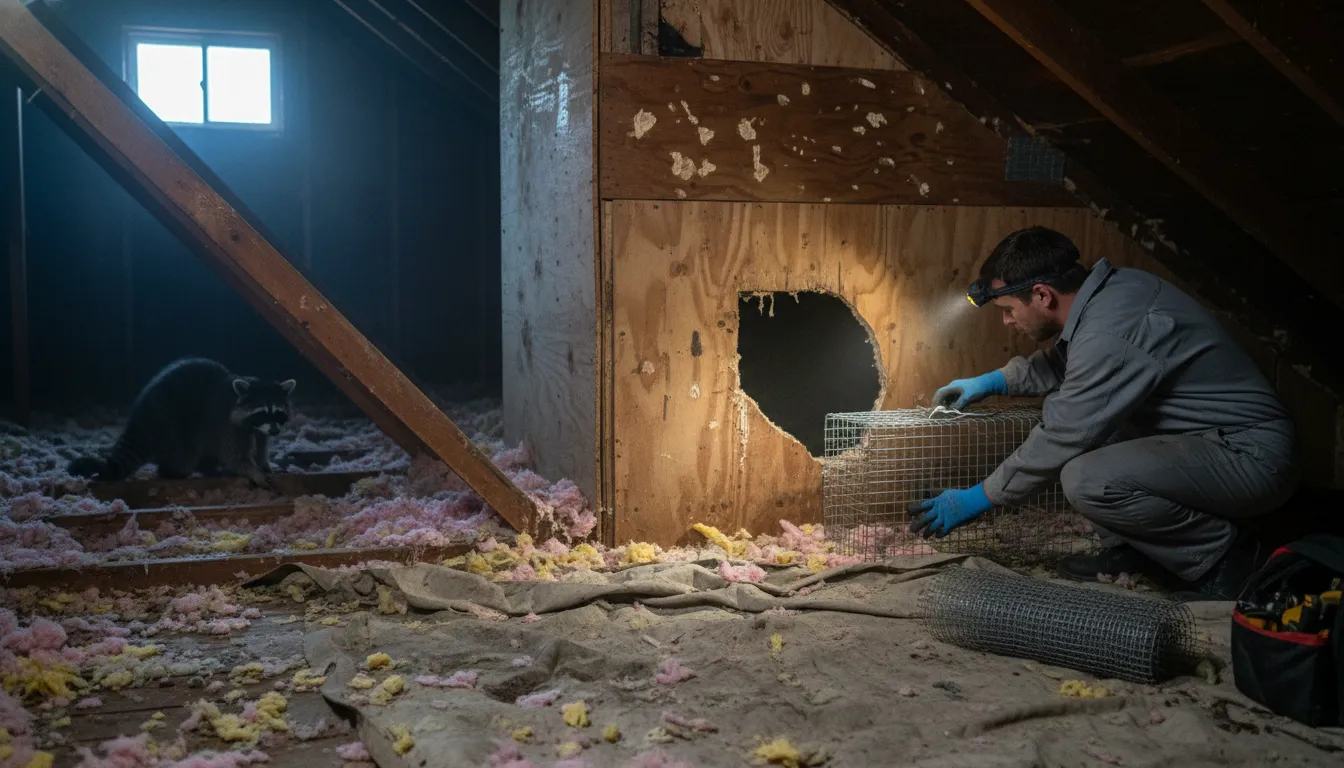
These animals are common culprits for attic invasions, chewing wires, and contaminating insulation. Removal often involves live trapping. It is crucial to remember that relocating trapped animals is generally discouraged and often illegal, as it can be cruel to the animal and may transfer problems to a new area. The focus should be on removal followed by comprehensive exclusion repairs to seal all potential entry points.
Woodchucks (Groundhogs) and Burrowing Animals
Woodchucks can undermine foundations, sheds, and decks with their extensive burrows. While a homeowner may trap a woodchuck on their property during the open season, a WCO is needed for out-of-season removal. Solutions often involve trapping and then reinforcing or collapsing burrows once the animal is gone.
Bird Nests in Vents or Chimneys
Migratory birds are federally protected. If birds have built a nest in a vent or chimney, you must wait until the young have fledged and left the nest before removing it and installing a proper wildlife-proof cap or screen. A professional can advise on timing and install preventative barriers.
Preventative Measures and Habitat Modification
The most effective long-term strategy for wildlife removal is to make your property less attractive to animals in the first place. This approach, called habitat modification, is encouraged by both UNH Extension and NH Fish and Game.
- Secure Food Sources: Keep trash in locked, wildlife-resistant bins. Do not leave pet food outdoors. Use bird feeders designed to be squirrel-resistant and clean up spilled seed regularly.
- Seal Entry Points: Conduct seasonal inspections of your roof line, siding, vents, and foundation. Seal any holes or gaps with sturdy materials like hardware cloth, sheet metal, or concrete. Remember, a mouse can fit through a hole the size of a dime.
- Use Barriers: Install chimney caps and vent screens. Use fencing buried at least a foot underground to deter digging animals like woodchucks and skunks.
- Manage Landscaping: Trim tree branches that overhang your roof. Keep woodpiles and dense brush away from your home's foundation.
Costs Associated with Wildlife Control
The cost of resolving a wildlife issue in New Hampshire varies widely based on the animal, the extent of the problem, and the required repairs.
- Professional Service Fees: Most companies charge for an initial inspection, followed by fees for removal/exclusion. For example, removing a raccoon family and sealing an attic may cost several hundred dollars, while a full bat exclusion for a large colony can cost significantly more. Always get a detailed written estimate.
- Licensing Costs (for Operators): The regulatory costs for professionals include license fees. For instance, a resident Level II WCO license had a fee of $135 plus a habitat fee, as of a 2018 document 7. These business costs are factored into service pricing.
- Prevention Investments: The cost of DIY preventative materials like chimney caps, hardware cloth, and sealants is relatively low and is a wise investment compared to the expense of a full-scale removal.
Legal and Humane Considerations
When dealing with wildlife, ethical and legal considerations are paramount. Lethal control should always be a last resort. New Hampshire law emphasizes humane treatment, and WCOs are trained in approved methods. Furthermore, the illegal relocation of wildlife is a significant concern, as it can lead to the animal's death from starvation or conflict and can spread diseases like rabies or distemper to new areas 8.
For any situation involving a potentially protected species, or if you are unsure of the best course of action, your first call should be to the New Hampshire Fish and Game Department or the UNH Extension for guidance 9 10. They can help you identify the animal and understand your legal options.
Frequently asked questions
Sources
Footnotes
-
Environmental Review | State of New Hampshire Fish and Game - https://www.wildlife.nh.gov/wildlife-and-habitat/nongame-and-endangered-species/environmental-review ↩
-
Chapter 212-A. Endangered Species Conservation Act - https://www.animallaw.info/statute/nh-endangered-chapter-212-endangered-species-conservation-act ↩
-
Endangered Species - Protections and Prohibited Actions - New Hampshire - https://www.fishwildlife.org/law-research-library/law-categories/endangered-species/endangered-species-protections-and-prohibited-actions-new-hampshire ↩
-
N.H. Admin. Code § Fis 308.02 - Licensing Requirements | State Regulations | US Law | LII / Legal Information Institute - https://www.law.cornell.edu/regulations/new-hampshire/N-H-Admin-Code-SS-Fis-308.02 ↩
-
NH Fish and Game - WILDLIFE CONTROL OPERATOR LICENSE - https://www.wildlife.nh.gov/sites/g/files/ehbemt746/files/documents/wildlife-control-operator.pdf ↩
-
New Hampshire Offers Tips for When Wildlife are Unwelcome - https://www.colonialpest.com/2014/05/07/new-hampshire-offers-tips-wildlife-unwelcome/ ↩
-
New Hampshire's Wildlife Control Operator Rules - https://legislature.vermont.gov/Documents/2018/WorkGroups/House%20Natural/Bills/H.636/H.636~Patrick%20Tate~New%20Hampshire's%20Wildlife%20Control%20Operator%20Rules~1-31-2018.pdf ↩
-
Outside/Inbox: Is it detrimental to relocate nuisance animals? - NHPR - https://www.nhpr.org/environment/2022-10-28/outside-inbox-is-it-detrimental-to-relocate-nuisance-animals ↩
-
Wildlife Control Operators | State of New Hampshire Fish and Game - https://www.wildlife.nh.gov/wildlife-and-habitat/nuisance-wildlife/wildlife-control-operators ↩
-
Nuisance Wildlife In & Around the Home - UNH Extension - https://extension.unh.edu/resource/nuisance-wildlife-around-home ↩