Find the Best Wildlife Removal Companies for Your Business
No obligation • Fast responses • Nationwide coverage

Why you can trust Pest Crews
Pest Crews is a leading U.S. resource for finding and evaluating residential and commercial pest control services. Our team researches providers, reviews treatment approaches, and organizes unbiased information to help you make informed decisions. Companies cannot pay to change our editorial content or influence how they appear.
Search providers near you
Best Wildlife Removal Companies in Vermont Ranked
When wild animals like raccoons, skunks, or bats move into your attic, chimney, or under your deck, they can cause significant damage and pose health risks. Professional wildlife removal addresses these problems by safely and legally evicting animals, sealing entry points, and cleaning up waste. This guide explains Vermont's specific regulations, outlines the removal process, and helps you understand how to find qualified local specialists to resolve your nuisance wildlife issue.
Understanding Vermont's Wildlife Removal Laws
Vermont has clear regulations governing the removal of nuisance animals, designed to balance property protection with wildlife conservation. Understanding these rules is the first step for any homeowner or business facing an animal intrusion.
Property Owner Rights and Limits Vermont law allows a landowner, their employee, tenant, or caretaker to take wild animals that are causing damage to their property. This means you have the right to address an immediate threat. However, this right comes with important restrictions. The use of poisons, explosives, and toothed traps or snares is generally prohibited 1. Furthermore, it is illegal to take, possess, or transport any species listed as state or federally endangered or threatened without a specific permit.
Protected Species in Vermont You cannot remove protected species without authorization. Vermont's threatened and endangered species list includes mammals like the Indiana bat, Northern long-eared bat, and Canada lynx, as well as various birds, fish, and mollusks 2 3. Common nuisance animals like raccoons, skunks, coyotes, beavers, and foxes are classified as furbearers. While they may be taken in defense of property, special rules apply, especially for commercial removal.
When You Need a Permit or License
For situations beyond simple, immediate action, permits and licenses are often required. This is especially true for ongoing problems or when hiring a professional.
- Depredation Permits: The Vermont Fish & Wildlife Department may issue a wildlife depredation permit for taking animals causing damage, but typically only after non-lethal methods have failed 4. The department prefers that property owners attempt humane deterrents first.
- Trapping License for Commercial Operators: This is a critical rule for homeowners to know: anyone, including businesses, who traps furbearing animals for compensation or offers trapping services in defense of property must have a valid Vermont trapping license 5. Always verify a professional holds this license.
- Endangered Species Permit: A separate permit from the Agency of Natural Resources is required to take or impact a threatened or endangered species or its habitat 6. An exception exists for bat exclusion specialists who follow Vermont's Best Management Practices and report their work 7 8.
- Reporting Requirements: If a furbearer is taken during its closed season in defense of property, the law requires notifying the Vermont Fish & Wildlife Commissioner within 84 hours.
Common Wildlife Problems and Removal Strategies
Different animals require different removal approaches. Here's a look at common Vermont intruders and how professionals handle them.
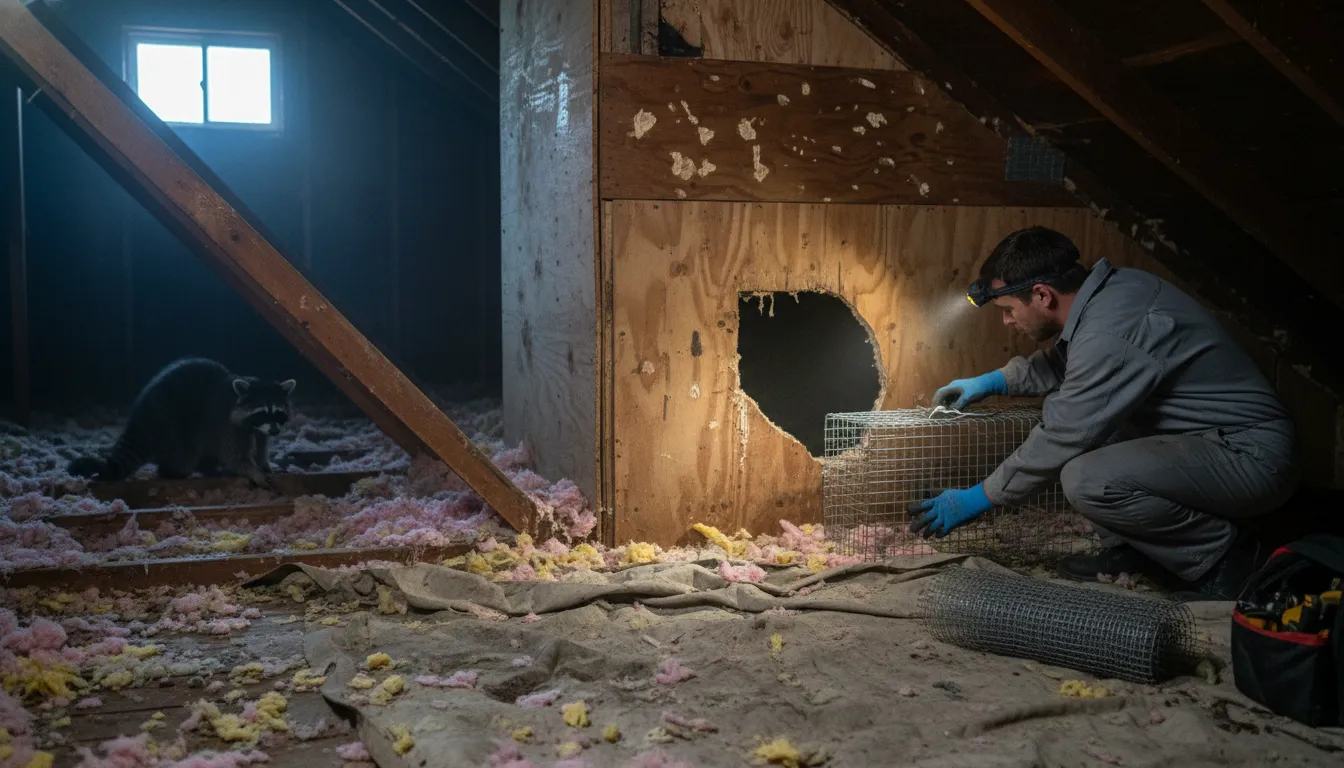
Raccoons These intelligent animals often seek shelter in attics, chimneys, and crawl spaces, tearing insulation and ductwork. Removal typically involves live trapping (where legal) and exclusion-sealing all potential entry points after ensuring no animals are left inside. Costs for raccon removal in an attic often range from $425 to $615.
Bats Bat colonies in buildings are a common issue. It is illegal to kill bats in Vermont, especially protected species. Professional removal focuses on bat exclusion, which involves installing one-way doors that allow bats to leave but not re-enter, after which all entry gaps are sealed. This service typically costs between $300 and $579, though complex nest or vent removal can exceed $1,000 9.
Skunks and Opossums These animals often den under porches, sheds, or decks. Removal usually involves live trapping and relocation in accordance with state regulations, followed by installing barriers to prevent re-entry. Skunk removal can cost between $325 and $500, while opossum removal generally ranges from $150 to $350 10.
Rodents (Squirrels, Mice, Rats) While often considered general pests, larger rodents like squirrels can require wildlife removal techniques. Professionals will identify entry points, use traps or excluders, and seal the structure. This process is different from standard pest control due to the size of the animals and the potential for structural damage.
Find the perfect wildlife removal companies for your needs
Get personalized recommendations and expert advice
The Professional Wildlife Removal Process
Hiring a licensed professional ensures the job is done safely, effectively, and legally. Here's what a standard service entails:
- Inspection and Assessment: A thorough inspection identifies the animal species, entry points, damage, and the scope of the infestation. Most professionals charge an initial fee for this service, which can be around $329 for a trapping setup 11.
- Humane Removal and Trapping: Using methods compliant with Vermont law, the professional will remove the animals. This may involve live traps, exclusion devices, or hands-on removal. There is often a per-animal removal fee in addition to the setup cost.
- Exclusion and Repair: This is the most critical step to prevent recurrence. All identified entry points are sealed with durable materials like steel mesh, hardware cloth, or chimney caps. Minor repairs to damaged soffits, vents, or roofing may be included.
- Cleanup and Sanitation: Animal droppings, urine, and nesting materials pose health risks and can attract insects. Professionals will remove contaminated insulation and apply enzymatic cleaners and disinfectants to sanitize the area.
- Prevention Advice: A good specialist will provide recommendations for making your property less attractive to wildlife, such as securing trash cans, trimming tree branches away from the roof, and removing outdoor food sources.
Cost of Wildlife Removal in Vermont
The cost of animal removal in Vermont varies widely based on the animal's location, the species, and the complexity of the work required. Here's a general breakdown:
- Small Job (e.g., one-time removal from a yard): Starting around $100.
- Medium Job (e.g., animals inside a home, requiring minor repairs): Starting around $300.
- Large Job (e.g., multiple animals, complex exclusion, major repairs): $500 and up 12 13.
- Per-Service Fees: Many companies charge an initial inspection/setup fee, plus a per-animal fee for trapping and removal.
These are estimates; always get a detailed, written quote from any service provider.
How to Choose a Wildlife Removal Service in Vermont
Selecting the right professional is crucial. Use this checklist to vet potential companies:
- Verify Licensing: Confirm the company holds a valid Vermont trapping license if they are handling furbearers for compensation 14 15.
- Check Insurance: Ensure they carry liability and worker's compensation insurance to protect you and your property.
- Ask About Methods: Inquire about their removal techniques. They should emphasize humane, legal methods and a strong focus on exclusion and prevention.
- Get Detailed Quotes: Obtain written estimates that break down inspection, removal, exclusion, repair, and cleanup costs. Be wary of quotes that seem unusually low.
- Ask About Guarantees: A reputable company should offer a warranty on their exclusion work, promising to return if animals regain entry within a certain period.
- Contact Vermont Fish & Wildlife: For further guidance or to find a licensed nuisance wildlife control operator, you can contact the Vermont Fish & Wildlife Department directly.
The Importance of Ethical and Legal Removal
"Trap and dump" methods-trapping an animal and releasing it on another property-are illegal, unethical, and often ineffective. Relocated animals struggle to survive, can spread disease, and simply create a problem for someone else. Vermont wardens actively discourage this practice 16. Professional, ethical removal focuses on solving the problem at your property through exclusion, which is the only long-term solution.
Frequently asked questions
Sources
Footnotes
-
Revised Regulated Trapping Rule Overview | Vermont Fish & ... - https://www.vtfishandwildlife.com/furbearers-and-trapping/furbearer-hunting-and-trapping/revised-regulated-trapping-rule-overview ↩
-
Vermont - Listed Species - https://ecos.fws.gov/ecp/report/species-listings-by-state?stateAbbrev=VT&stateName=Vermont&statusCategory=Listed ↩
-
Endangered species of Vermont - List - https://www.earthsendangered.com/search-regions3.asp?mp=&search=1&sgroup=allgroups&ID=389 ↩
-
Human-Wildlife Conflicts Control - https://www.vtfishandwildlife.com/form/human-wildlife-conflicts-control ↩
-
TRAPPING IN DEFENSE OF PROPERTY | protectourwildlifevt - https://www.protectourwildlifevt.org/trapping-in-defense-of-property ↩
-
Vermont Agency of Natural Resources - https://cdnsm5-hosted.civiclive.com/UserFiles/Servers/Server_73079/File/Learn%20More/Threatened%20and%20Endangered%20Species/TE%20Taking%20Permit/ANRTandEPermitFAQ_8-5-2015.pdf ↩
-
Human-Wildlife Conflicts Control - https://www.vtfishandwildlife.com/form/human-wildlife-conflicts-control ↩
-
The Vermont Statutes Online - https://legislature.vermont.gov/statutes/fullchapter/10/105 ↩
-
Burlington Wildlife Control Of Vermont - https://www.pestwildliferemoval.com/vermont/burlington-wildlife-control/ ↩
-
Affordable Wildlife Removal Cost - https://critterohio.com/how-much-does-wildlife-removal-cost/ ↩
-
How Much Does Wildlife Removal Cost? - Angie's List - https://www.angi.com/articles/what-cost-animal-removal.htm ↩
-
Southern Vermont Wildlife Animal Control - http://www.wildlifeanimalcontrol.com/Southern-Vermont.html ↩
-
How Much Does Animal & Wildlife Removal Cost? (2026) - https://homeguide.com/costs/animal-and-wildlife-removal-costs ↩
-
Human-Wildlife Conflicts Resources - https://www.vtfishandwildlife.com/learn-more/living-with-wildlife/human-wildlife-conflicts-resources ↩
-
title 10 V.S.A. 4828 - Vermont Laws - https://legislature.vermont.gov/statutes/section/10/113/04828 ↩
-
Wild animals should not be trapped and dumped, wardens say - https://www.mynbc5.com/article/dont-trap-and-dump-animals/60388101 ↩