Find the Best Wildlife Removal Companies for Your Business
No obligation • Fast responses • Nationwide coverage

Why you can trust Pest Crews
Pest Crews is a leading U.S. resource for finding and evaluating residential and commercial pest control services. Our team researches providers, reviews treatment approaches, and organizes unbiased information to help you make informed decisions. Companies cannot pay to change our editorial content or influence how they appear.
Search providers near you
Best Wildlife Removal Companies in West Virginia Ranked
Dealing with unwelcome wildlife on your property can be stressful and potentially damaging. In West Virginia, all wildlife is owned by the state and protected by law, making it essential to handle any nuisance situation correctly and legally. This guide explains the state's specific regulations, your options for resolving wildlife conflicts, and how to find qualified local professionals who can help you address the problem safely and in compliance with West Virginia law.
Understanding West Virginia's Wildlife Ownership Laws
A foundational principle in West Virginia is that all wild animals are considered property of the state, held in trust for the benefit of all citizens 1 2. This legal status means you cannot simply trap, kill, or relocate an animal causing problems on your land. Specific state regulations govern how and when wildlife can be managed when it becomes a nuisance. The West Virginia Division of Natural Resources (WVDNR) is the agency responsible for administering these rules and protecting the state's wildlife resources.
The goal of these laws is to balance the needs of people with the conservation of animal populations. Whether you're dealing with raccoons in the attic, squirrels in the walls, or deer eating your garden, understanding these rules is the first step toward a legal and effective solution.
Categories of Nuisance Wildlife in West Virginia
Not all animals are treated the same under state regulations. The WVDNR classifies species into different groups, which determines the process required for their management.
General Nuisance Wildlife
This category includes the most common species that cause conflicts in residential and agricultural settings. Property owners typically have more straightforward options for dealing with these animals, though permits are still often required. Common species in this group include:
- Opossums
- Moles and voles
- Rabbits
- Squirrels (gray, fox, red)
- Woodchucks (groundhogs)
- Raccoons
- Foxes
- Skunks
- Coyotes
- Non-protected species of bats
- Non-native birds like pigeons, house sparrows, and starlings
Species Requiring Special WVDNR Approval
Certain game animals and furbearers cannot be handled without direct authorization from the WVDNR. If you have a conflict with one of these species, you must contact your local WVDNR district wildlife biologist and a natural resources police officer before taking any action. This group includes:
- White-tailed deer
- Black bear
- Bobcat
- Fisher
- Beaver
- Otter
- Wild turkey 3
Federally and State Protected Species
These animals receive the highest level of protection under the Endangered Species Act and state law. It is illegal to harm, harass, or possess them without specific federal and state permits, which are generally only issued to licensed professionals for scientific or conservation purposes. This list includes:
- Northern long-eared bat
- Indiana bat
- Virginia big-eared bat
- Cheat Mountain salamander
- Various other threatened and endangered species
- All migratory birds (including nests and eggs), which are protected under the federal Migratory Bird Treaty Act 4. Handling conflicts with protected birds requires a separate U.S. Fish and Wildlife Service depredation permit.
Your Legal Options for Wildlife Control
When wildlife is causing damage to your property-such as destroying crops, gardens, landscaping, or entering structures-you have two primary legal pathways in West Virginia [^14] [^15].
Option 1: Do-It-Yourself with a Wildlife Damage Permit
If you wish to handle the situation yourself, you must first obtain the proper authorization from the WVDNR.
- Report the Damage: Contact the WVDNR to report the substantial property damage you are experiencing.
- Investigation: A natural resources police officer may investigate to verify the damage and identify the offending species.
- Permit Issuance: If approved, the WVDNR may issue you a Wildlife Damage Permit. This permit will specify the number of animals you are authorized to take (trap or kill) and the prescribed methods you must use 5 6.
- Critical Rules for Permit Holders: A key rule is that trapped animals must be released on the same property where they were caught or humanely euthanized 7 8. Relocating wildlife to another location, including public lands, is illegal without prior written approval from the WVDNR, as it can spread disease and create problems for others 9.
Option 2: Hire a Licensed Wildlife Damage Control Agent (WDCA)
For most homeowners and businesses, hiring a professional is the most practical and legally sound choice. The WVDNR licenses Wildlife Damage Control Agents who are trained in state laws, humane methods, and effective exclusion techniques.
- What They Do: These licensed agents are authorized to trap and dispose of nuisance wildlife in full compliance with state regulations 10 11. They can handle the entire process, from inspection and removal to exclusion (sealing entry points) and repair.
- Finding an Agent: The WVDNR provides a list of licensed Wildlife Damage Control Agents. You can contact your nearest WVDNR district office to obtain this list and get guidance on your specific situation.
Find the perfect wildlife removal companies for your needs
Get personalized recommendations and expert advice
What to Expect: Services and Associated Costs
The WVDNR does not regulate the fees charged by private Wildlife Damage Control Agents; pricing is set by individual businesses based on the service required 12 [^17]. Costs can vary significantly depending on the animal species, the extent of the infestation or damage, the complexity of the removal, and your location within West Virginia.
Here is a breakdown of common service components and their potential cost ranges:
- Initial Inspection/Service Fee: Most professionals charge a base fee to visit your property, assess the problem, and provide a diagnosis and quote. This typically ranges from $75 to $200 or more 13 [^21].
- Removal Fees: The cost to physically remove the animals can be structured per animal or as a flat project rate. For example:
- Removal of a single raccoon or squirrel from an attic might cost a few hundred dollars.
- Complex removals, such as extracting a colony of bats from a home's structure or dealing with numerous snakes, can run into the thousands of dollars due to the specialized equipment and labor involved [^22] [^23].
- Exclusion and Repair Work: This is often the most critical and costly part of wildlife control. Simply removing animals is not a solution if they can re-enter. Exclusion involves permanently sealing all potential entry points with durable materials like steel mesh, chimney caps, and vent covers. Repairing damage caused by wildlife (chewed wires, soiled insulation, structural damage) adds to the cost. A comprehensive exclusion project can be a significant investment but is essential for a permanent resolution [^24].
When obtaining quotes, ensure the provider is a WVDNR-licensed Wildlife Damage Control Agent. Ask for a detailed breakdown of costs that includes inspection, removal, exclusion materials and labor, cleanup, and any necessary repairs.
The Professional Wildlife Removal Process
When you hire a licensed professional in West Virginia, you can expect a multi-step process designed to solve the problem humanely and permanently.
- Thorough Inspection: The agent will perform a detailed inspection of your property, inside and out, to identify the species, locate all entry points, and assess the extent of the damage.
- Customized Plan: Based on the inspection, the professional will present a plan that includes removal strategies, exclusion work, cleanup, and repairs. They will also explain how their methods comply with West Virginia wildlife laws.
- Humane Removal: Using live traps or other WVDNR-approved methods, the animals will be removed. As per state law, the agent will then either euthanize the animals humanely or, in some specific cases and with proper approval, may have other legal disposal options.
- Exclusion and Sealing: After removal, the technician will seal every identified entry point with professional-grade materials to prevent future intrusions. This step is what differentiates a true wildlife control expert from someone who merely traps animals.
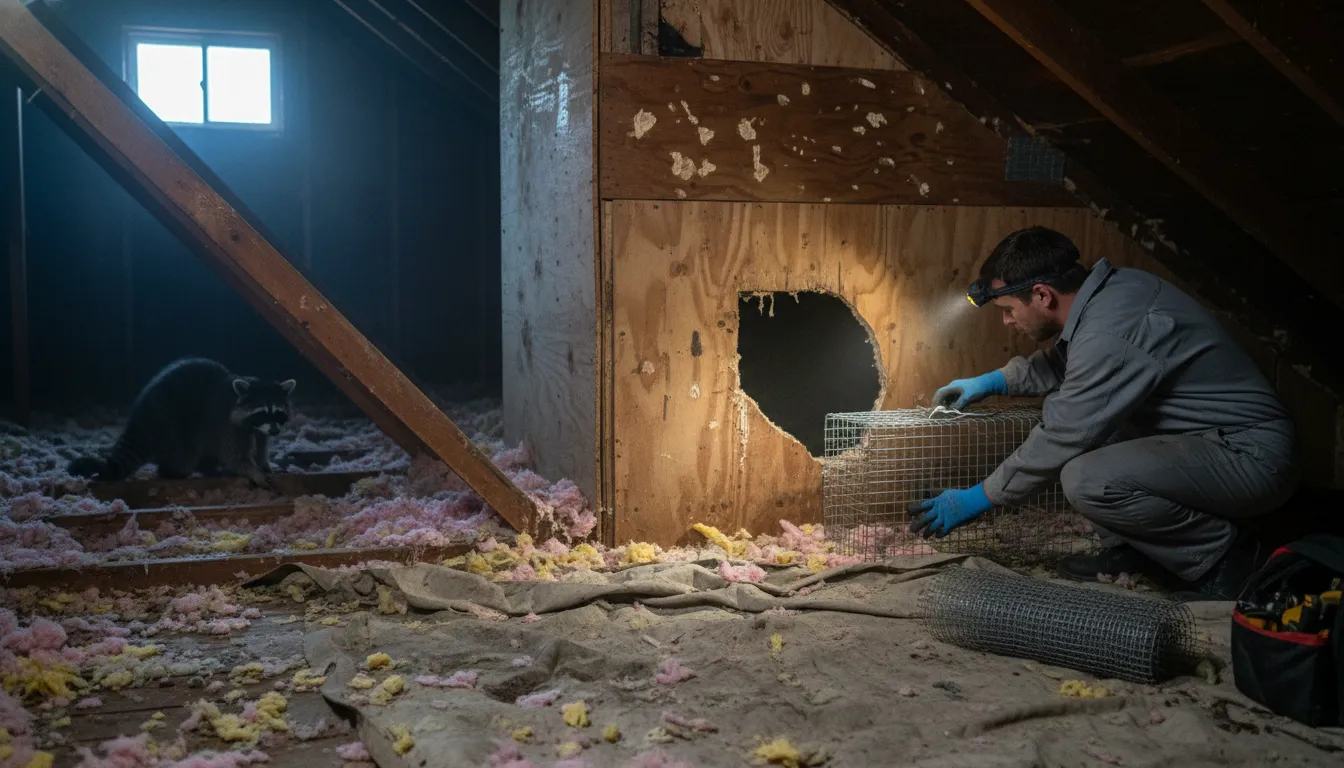
- Cleanup and Restoration: Wildlife leaves behind droppings, urine, nesting materials, and odors that can pose health risks and attract new animals. Professionals offer cleanup, sanitization, and insulation replacement services. They can also repair structural damage like chewed fascia boards or roof vents.
- Follow-up and Warranty: Many reputable companies offer a warranty period on their exclusion work and may schedule follow-up visits to ensure the problem is fully resolved and no new entry points have been created.
Preventing Future Wildlife Conflicts
Once your immediate problem is solved, taking proactive steps can help keep your property wildlife-free.
- Secure Food Sources: Keep pet food indoors, use secure lids on garbage cans, and clean barbecue grills.
- Eliminate Shelter: Seal off crawlspace openings, cap chimneys, and repair broken vents. Keep tree branches trimmed back from the roofline.
- Manage Landscaping: Reduce dense brush piles and tall grass near your home's foundation.
- Regular Maintenance: Periodically inspect your home's exterior, especially after storms, for any new gaps or potential entry points.
Frequently asked questions
Sources
Footnotes
-
Email: Chapter 20, Article 2 - West Virginia Code - https://code.wvlegislature.gov/email/20-2/ ↩
-
19.35.5 NMAC - https://www.srca.nm.gov/parts/title19/19.035.0005.html ↩
-
TITLE 58 - https://apps.sos.wv.gov/adlaw/csr/readfile.aspx?DocId=26684&Format=WORD&KeyWord= ↩
-
West Virginia Ecological Services Field Office | Species - https://www.fws.gov/office/west-virginia-ecological-services/species ↩
-
W. Va. Code R. § 58-41-7 - Procedures | State Regulations - https://www.law.cornell.edu/regulations/west-virginia/W-Va-C-S-R-SS-58-41-7 ↩
-
W. Va. Code R. § 58-15-7 - Issuance of Permits - https://www.law.cornell.edu/regulations/west-virginia/W-Va-C-S-R-SS-58-15-7 ↩
-
Nuisance Wildlife in West Virginia - WVDNR - https://wvdnr.gov/plants-animals/nuisance-wildlife/ ↩
-
W. Va. Code R. § 58-41-8 - Disposition of Nuisance Wildlife - https://www.law.cornell.edu/regulations/west-virginia/W-Va-C-S-R-SS-58-41-8 ↩
-
TITLE 58 - https://apps.sos.wv.gov/adlaw/csr/readfile.aspx?DocId=16244&Format=WORD&KeyWord= ↩
-
20-2-50a. Wildlife damage control agents - West Virginia Code - https://code.wvlegislature.gov/20-2-50A/ ↩
-
West Virginia Code | §20-2-15 - https://code.wvlegislature.gov/20-2-15/ ↩
-
Assistance in West Virginia - WildlifeHelp.org - https://wildlifehelp.org/assistance-west-virginia ↩
-
PDF - West Virginia Secretary of State - Online Data Services - https://apps.sos.wv.gov/adlaw/csr/readfile.aspx?DocId=25904&Format=PDF ↩