Find the Best Wildlife Removal Companies for Your Business
No obligation • Fast responses • Nationwide coverage

Why you can trust Pest Crews
Pest Crews is a leading U.S. resource for finding and evaluating residential and commercial pest control services. Our team researches providers, reviews treatment approaches, and organizes unbiased information to help you make informed decisions. Companies cannot pay to change our editorial content or influence how they appear.
Search providers near you
Best Wildlife Removal Companies in Wyoming Ranked
Finding an uninvited animal in your Wyoming home, barn, or business can be unsettling. Whether it's a raccoon in the attic, a skunk under the deck, or birds nesting in a vent, knowing how to handle the situation legally and effectively is crucial. Wildlife removal in Wyoming is governed by a specific set of rules from the Wyoming Game and Fish Department (WGFD) that vary dramatically by species. This guide explains the regulations, clarifies which animals you can handle yourself, and outlines when you must call a licensed professional. It's designed to help you navigate the process of finding qualified local experts who can resolve your wildlife issue safely and in full compliance with state and federal law.
Understanding Wyoming's Wildlife Classifications
The first step in any wildlife conflict is identifying the animal, as Wyoming law categorizes species differently, dictating the legal response. The WGFD classifies animals into distinct groups: protected species, furbearers, predatory animals, and nongame wildlife. Each category has its own regulations regarding removal, permits, and acceptable methods.
Protected Species are strictly regulated. This group includes all federally and state-listed threatened or endangered animals, such as the black-footed ferret, Canada lynx, grizzly bear, and Wyoming toad 1 2. It is illegal to take, harm, or harass these animals without specific, hard-to-obtain permits from both the WGFD and the U.S. Fish and Wildlife Service (USFWS). Most migratory birds, their eggs, and their active nests are also federally protected, requiring special authorization for any disturbance.
Furbearing Animals like badgers, beavers, bobcats, martens, minks, muskrats, and weasels can only be taken by someone with a valid furbearing animal hunting or trapping license during specific, regulated seasons 3 4. Outside of these seasons or without the proper license, a permit is required for their removal, even if they are causing a nuisance.
Predatory Animals are the category where homeowners have the most leeway. In Wyoming, this includes coyotes, jackrabbits, porcupines, raccoons, red foxes, stray cats, and striped skunks 5. These animals may be taken on private land without a license and at any time of year, provided it is done in a manner consistent with local ordinances and animal cruelty laws 6. This means you can legally trap or remove these animals yourself or hire someone to do it without needing a WGFD permit specifically for the take of the animal.
Nongame Wildlife encompasses all other wild animals not classified as game, furbearers, or predators. Taking nongame wildlife generally requires a permit from the WGFD. This broad category highlights why positive identification is so important before any action is taken.
When to Call a Professional Wildlife Control Operator
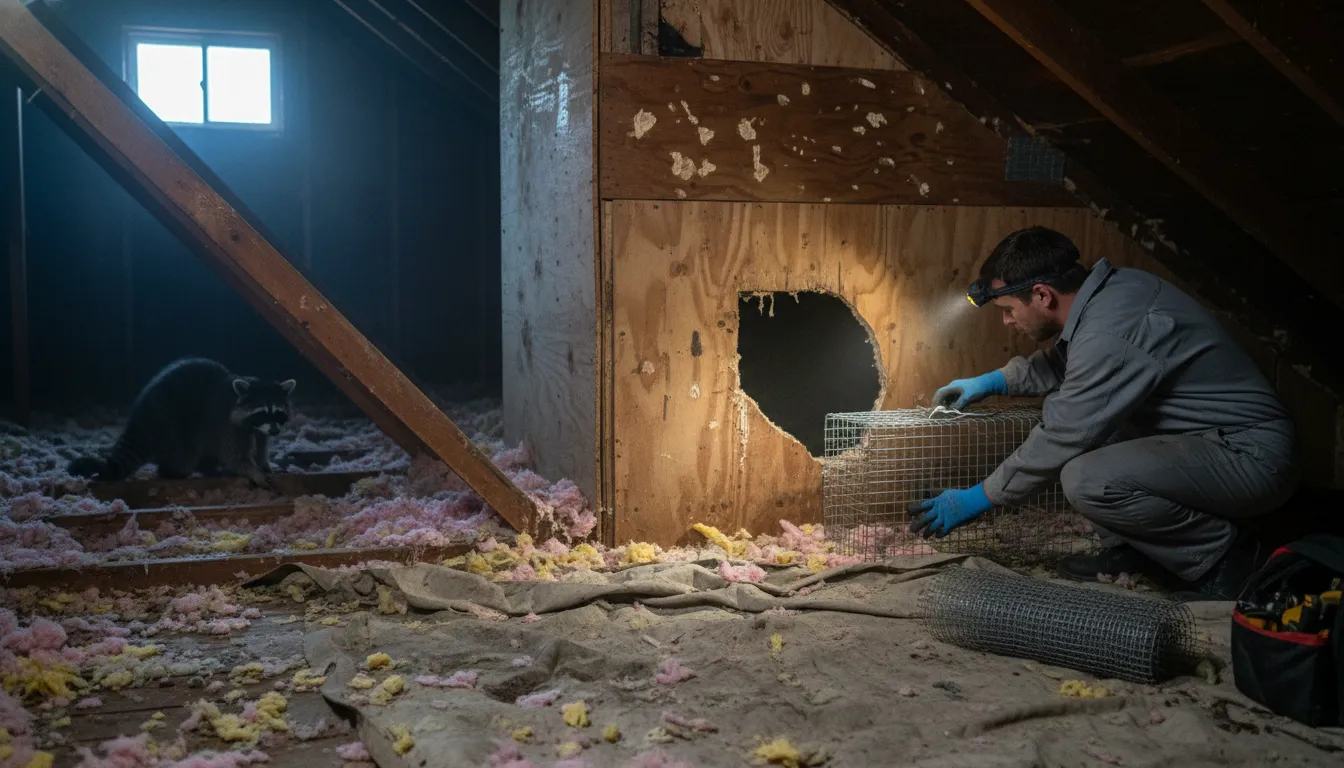
While you may legally remove a predatory animal like a raccoon yourself, there are compelling reasons to hire a professional wildlife removal service.
- Safety: Wild animals can be aggressive when cornered, carry diseases (like rabies or distemper), and host parasites. Professionals have the training and protective equipment to handle animals safely.
- Humane Expertise: Ethical trapping and relocation require knowledge of animal behavior. Professionals use species-appropriate traps and understand laws regarding humane treatment and legal relocation sites.
- Complete Solutions: Removing the animal is often only half the battle. Professionals specialize in animal exclusion-finding and sealing the entry points that allowed the animal inside in the first place. Without proper exclusion, the problem will likely recur.
- Cleanup and Sanitation: Wildlife leaves behind droppings, urine, nesting materials, and food caches that can damage structures and pose health risks. Many services offer biohazard cleanup and decontamination.
- Legal Compliance: For any animal that is not a predatory species, a professional must operate under the appropriate WGFD or USFWS permits 7. A reputable operator will have these credentials, protecting you from unintentional violations that can carry significant fines.
Find the perfect wildlife removal companies for your needs
Get personalized recommendations and expert advice
The Wildlife Removal Process: What to Expect
A professional service typically follows a structured process to ensure a permanent resolution.
- Inspection and Assessment: A technician will perform a thorough inspection of your property to identify the species, locate entry points, and assess the extent of the infestation or damage. This initial visit usually incurs a fee, often ranging from $100 to $300 8.
- Removal Plan and Quote: Based on the inspection, the professional will present a plan detailing the removal method, necessary exclusion repairs, and any cleanup services. They should provide a clear, written estimate.
- Safe Removal: Using live traps, one-way doors, or other direct capture methods, the technician will remove the animals. The method depends on the species and situation.
- Exclusion and Repair: This critical step involves sealing all potential entry points with durable materials like steel mesh, hardware cloth, or specialized chimney caps to prevent re-entry. For bats or birds, this is a meticulous process to ensure all animals are out before sealing.
- Cleanup and Restoration: The affected area is cleaned, disinfected, and deodorized. In cases of significant damage from animals like beavers or rodents, restoration repairs to insulation, wiring, or ductwork may be necessary.
- Follow-up: Many reputable companies offer a warranty period on their exclusion work and will schedule a follow-up visit to ensure the problem is resolved.
Cost Factors for Wildlife Removal in Wyoming
Prices for animal control services in Wyoming vary widely based on several key factors. It's wise to get multiple estimates.
- Type of Animal: Common nuisance animals like raccoons, skunks, or squirrels typically cost less to remove than a colony of bats or birds, which requires more labor-intensive exclusion 9 10.
- Number of Animals and Severity: A single animal is less expensive than a family group. Extensive damage or contamination will increase costs.
- Location and Accessibility: An animal in an easy-to-reach crawlspace is simpler than one trapped in a high attic or inside a wall void.
- Services Required: Basic trapping is less costly than a full-service package including exclusion, decontamination, and repairs.
Here are general national cost estimates, which can be applied as a guideline for Wyoming services 11 12:
- Raccoons, Skunks, Squirrels: Live trapping and removal often range from $300 to over $1,000+, depending on the number of animals and complexity.
- Bat or Bird Colony Removal: Exclusion work and cleanup for bats or birds like swallows or pigeons can cost $500 to several thousand dollars due to the scale of sealing required and potential biohazard cleanup.
- Beaver Dam Removal/Control: Mitigating beaver activity and removing dams is highly variable but can run into the hundreds to thousands of dollars, depending on the equipment needed and extent of the flooding or damage.
- Major Wildlife (Bears, Mountain Lions): These are typically managed directly by WGFD personnel if there is an immediate threat. Private services for preventative measures (e.g., installing electric fencing) are available at a higher cost.
Legal Responsibilities and Best Practices
Before initiating any control measures, especially lethal ones, contacting the Wyoming Game and Fish Department is a recommended best practice to ensure full compliance 13. Always verify the credentials of any wildlife removal professional you hire. Ask if they carry the necessary WGFD permits for the species involved, particularly for birds, bats, or furbearers outside of hunting season.
For predatory animals, non-lethal hazing-such as using noise or motion-activated devices to scare animals away from property-is always allowed without a permit, as long as the animals are not harmed 14. This can be an effective first step for occasional visitors like coyotes or foxes.
Remember, the goal of modern wildlife control is conflict resolution, not just elimination. The most effective long-term strategy combines humane removal with proactive exclusion and habitat modification (like securing trash cans and removing food sources) to make your property less attractive to wildlife in the first place 15.
Frequently asked questions
Sources
Footnotes
-
Wyoming Ecological Services Field Office | Species - U.S. Fish and Wildlife Service ↩
-
Furbearing Animal Trapping | Wyoming Game & Fish Department ↩
-
Allen, do I need a license to trap or shoot a badger? - Wyoming Game and Fish ↩
-
52-1 CHAPTER 52 TAKE OF NONGAME WILDLIFE FROM ... - Wyoming Game and Fish Department ↩
-
How Much Does Wildlife Control and Exclusion Cost? - Terminix ↩
-
The Cost of Wildlife Removal: What You Need to Know - Coastal Wildlife Services ↩
-
Wildlife removal cost: What you need to know - AZ Big Media ↩
-
Urban & Nuisance Wildlife | Wyoming Game & Fish Department ↩
-
Urban & Nuisance Wildlife | Wyoming Game & Fish Department ↩
-
Wildlife Control Methods - National Wildlife Control Operators Association ↩