Find the Best Ant Control Companies for Your Business
No obligation • Fast responses • Nationwide coverage

Why you can trust Pest Crews
Pest Crews is a leading U.S. resource for finding and evaluating residential and commercial pest control services. Our team researches providers, reviews treatment approaches, and organizes unbiased information to help you make informed decisions. Companies cannot pay to change our editorial content or influence how they appear.
Search providers near you
Find Ant Control Companies near you
A persistent line of ants in your kitchen or a swarm of winged insects indoors is a clear sign it's time for professional ant control. These common household pests are more than a nuisance; certain species, like carpenter ants, can cause structural damage, while others can contaminate food and surfaces. Effective ant management requires correctly identifying the species and targeting the entire colony, which is often hidden deep within walls or underground. This guide explains the methods, costs, and considerations for finding a qualified local professional to resolve your ant problem for good.
Search providers near you
Why Professional Ant Extermination is Often Necessary
While store-bought sprays can kill the ants you see, they rarely solve the underlying problem. Ant colonies are complex, with a central queen producing thousands of workers. Killing foragers with a spray often just creates a temporary detour, as the colony simply sends out more workers. Professionals are trained in ant management strategies that target the colony's heart. They can accurately identify whether you're dealing with odorous house ants, pavement ants, carpenter ants, or fire ants-each requiring a different approach. Misidentification can lead to ineffective treatments and recurring infestations.
Common Methods Used in Ant Pest Control
Licensed exterminators use a combination of tactics, often under an Integrated Pest Management (IPM) framework, which prioritizes long-term prevention with the least possible hazard. The right method depends on the ant species, the location of the nest, and the environment.
Ant Baits (Gels, Granules, Stations)
This is one of the most effective strategies for colony elimination. Baits contain a slow-acting insecticide mixed with an attractive food source. Worker ants carry the bait back to the nest, where it is shared with the queen, larvae, and other workers, eventually destroying the entire colony. 1
- Effectiveness: High for long-term eradication, but requires patience as it can take several days to a few weeks to see full results.
- Best For: Indoor infestations where the nest is hidden, and for species like Argentine ants or pharaoh ants that have multiple queens.
Barrier and Perimeter Sprays
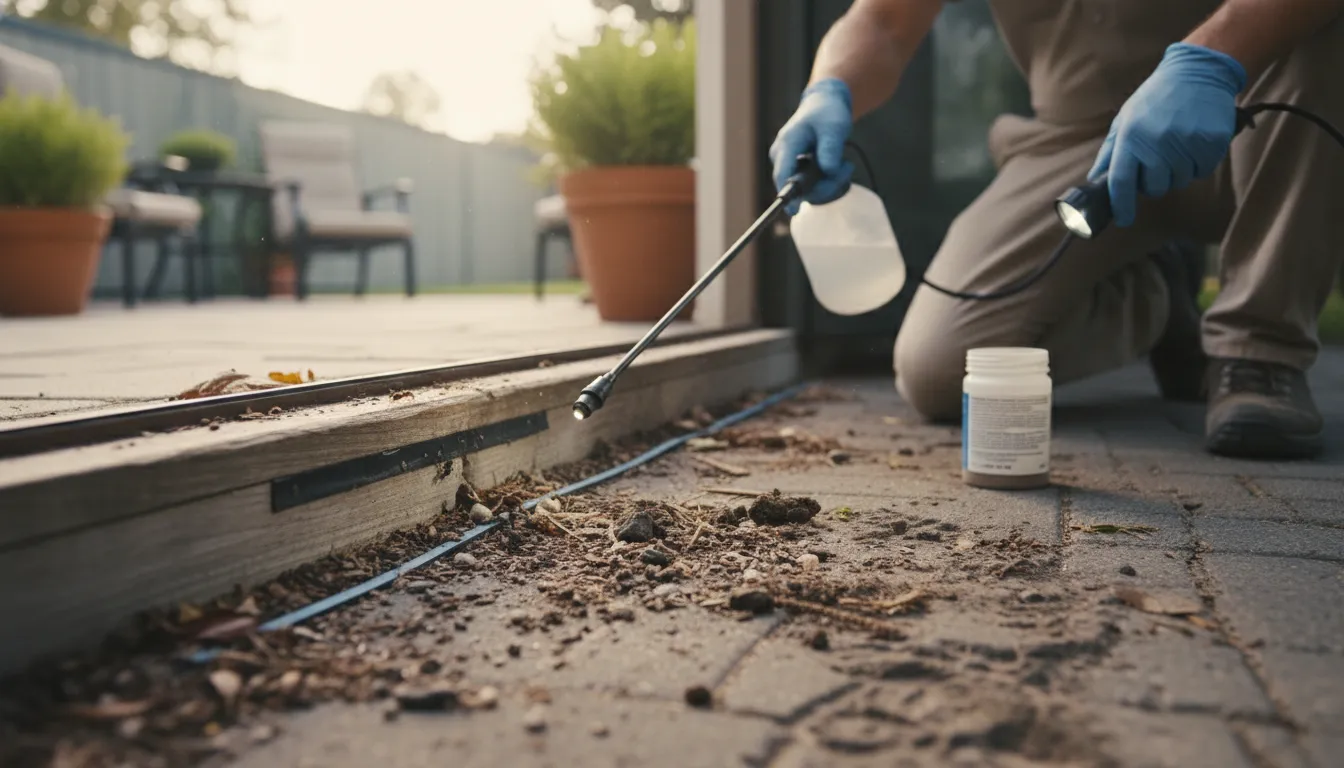
Liquid insecticides are applied around the exterior foundation, windows, doors, and other potential entry points to create a protective chemical barrier. This method kills ants on contact and deters new ones from crossing.
- Effectiveness: Moderate to high for immediate deterrence and reducing indoor ant traffic. However, it is often a short-term fix if used alone, as it doesn't eliminate the indoor colony. 2
- Best For: Preventing new ants from entering, especially during peak seasons, and as part of a broader treatment plan.
Direct Nest Treatments (Dusts and Mound Treatments)
For visible outdoor nests, such as fire ant mounds or carpenter ant colonies in a stump, professionals may apply insecticidal dusts or liquids directly into the nest entrance.
- Effectiveness: Very high for eliminating specific, accessible nests.
- Best For: Targeting fire ants in yards or other clearly located outdoor colonies.
Integrated Pest Management (IPM)
IPM is not a single product but a comprehensive approach. For ant removal, an IPM plan includes:
- Inspection & Identification: Determining the species and locating trails and nests.
- Sanitation: Advising on removing food and water sources that attract ants.
- Exclusion: Sealing cracks, gaps, and other entry points.
- Targeted Control: Applying baits or sprays only where needed, based on inspection findings.
- Monitoring: Following up to ensure the treatment was successful and preventing recurrence. 3 4
- Effectiveness: Considered the highest standard for sustainable, long-term ant prevention and control. 5
Find the perfect ant control companies for your needs
Get personalized recommendations and expert advice
Understanding the Cost of Ant Exterminator Services
The price for professional ant treatment varies widely based on several factors, including the ant species, the size and severity of the infestation, your property's square footage, and your geographic location. 6 7 8
Key Cost Factors
- Ant Species: Treating common sugar ants is generally less expensive than eradicating destructive carpenter ants or aggressive fire ants, which require more specialized methods.
- Infestation Severity: A small, localized trail of ants costs far less than a widespread infestation with multiple nests inside walls.
- Property Size: Larger homes require more product and time for a proper perimeter treatment and inspection.
- Service Type: A one-time visit differs in cost from an ongoing maintenance plan.
Residential Ant Control Pricing
Here is a general overview of what homeowners might expect to pay for ant extermination services: 9
| Service Type | Typical Price Range | Notes |
|---|---|---|
| One-Time Treatment | $80 - $500 | The average cost often falls between $150 and $300 for a standard infestation. |
| Carpenter Ant or Fire Ant Treatment | $250 - $500+ | Can reach $1,500 or more if there is structural damage requiring repair or if the infestation is severe. |
| Initial Visit + Ongoing Plan | Quarterly: $400-$500/year | Many companies recommend follow-up visits. Initial treatment may be separate, with quarterly maintenance priced as an annual package or monthly fee ($40-$70/month). |
Commercial Ant Control Considerations
For businesses, ant management is critical for health, safety, and reputation. Pricing is less standardized and is typically customized based on:
- Square Footage: Restaurants, warehouses, and office buildings are priced per square foot.
- Service Frequency: High-risk environments like food service may need monthly service, while an office might only need quarterly visits.
- Scope of Work: The complexity of the infestation and the specific protocols required (e.g., after-hours treatment, specialized baits). 10 11 12 13 Commercial contracts are often negotiated and include detailed service schedules and guarantees.
Choosing the Right Ant Control Provider
Selecting a professional is about more than just price. Here's what to look for:
- Licensing and Insurance: Always verify that the company holds a current pest control license for your state and carries liability insurance.
- Experience with Your Ant Species: Ask if they have specific experience dealing with the type of ant you have (e.g., carpenter ants, odorous house ants).
- Inspection Process: A reputable provider will conduct a thorough inspection before giving a quote or starting treatment.
- Treatment Plan Explanation: They should clearly explain their proposed method (baiting, spraying, IPM), why it's chosen, and what you can expect.
- Guarantee/Warranty: Many companies offer a warranty period where they will return for free if the ants return.
- Safety Protocols: They should be able to explain the safety of the products used around children, pets, and the environment.
Long-Term Ant Prevention Tips
After professional treatment, you can take steps to keep ants from returning:
- Eliminate Food Sources: Wipe down counters, store food in airtight containers, and manage trash diligently.
- Remove Water Sources: Fix leaky faucets and pipes, and ensure areas like sinks and pet bowls are dry.
- Seal Entry Points: Use caulk to seal cracks in foundations, around windows, and where utility pipes enter.
- Manage Landscaping: Keep tree branches and shrubs trimmed away from the house. Store firewood away from the structure and off the ground.
- Schedule Regular Inspections: Consider an ongoing maintenance plan, especially if you live in an area prone to specific ant problems.
Frequently asked questions
Sources
Footnotes
-
Getting Rid of Ants - Baiting vs. Spraying? - Turner Pest Control - https://www.turnerpest.com/getting-rid-of-ants-baiting-vs-spraying/ ↩
-
Do Ant Sprays Work For Keeping Ants Away? - Bug Out - https://www.bugoutservice.com/ant-exterminators/ant-control/spraying-for-ants-does-it-work/ ↩
-
Ants / Home and Landscape / UC Statewide IPM Program (UC IPM) - https://ipm.ucanr.edu/home-and-landscape/ants/ ↩
-
Managing Pests in Gardens: Controls: Ant ... - UC IPM - https://ipm.ucanr.edu/PMG/GARDEN/CONTROLS/antmanagement.html ↩
-
Effective Ant Control: Top 5 Proven Tips - https://bigginsexterminating.com/effective-ant-control/ ↩
-
How much does an exterminator cost for ants: 2025 Best Tips - https://bigginsexterminating.com/how-much-does-an-exterminator-cost-for-ants/ ↩
-
How Much Does an Ant Exterminator Cost in 2025? - https://www.homeadvisor.com/cost/environmental-safety/ant-exterminator/ ↩
-
How Much Does an Ant Exterminator Cost? [2026 Data] | Angi - https://www.angi.com/articles/how-much-does-it-cost-get-rid-ants.htm ↩
-
How Much Does an Ant Exterminator Cost? (2026) - HomeGuide - https://homeguide.com/costs/ant-exterminator-cost ↩
-
Effective Ant Control for Businesses: Identification, Techniques, and ... - https://www.envirogpc.com/blog/2025/april/4-steps-to-help-identify-ants-at-your-business/ ↩
-
The ultimate guide to pest control pricing - Method CRM - https://www.method.me/pricing-guides/pest-control-prices-list/ ↩
-
How To Establish Pest Control Prices: A Guide For Businesses - https://www.fieldroutes.com/blog/how-to-establish-pest-control-prices-a-guide-for-businesses ↩
-
Effective Ant Control for Businesses: Identification, Techniques, and Services - https://www.envirogpc.com/blog/2025/april/4-steps-to-help-identify-ants-at-your-business/ ↩